
ADMs in the Sponsorship Chain
Assistant Deputy Ministers (ADMs) sit at a critical juncture in Canada’s federal public service. Positioned between Deputy Ministers (DMs) and Directors General (DGs), they are expected to both translate ministerial and DM-level vision into operational reality and champion change across their portfolios.
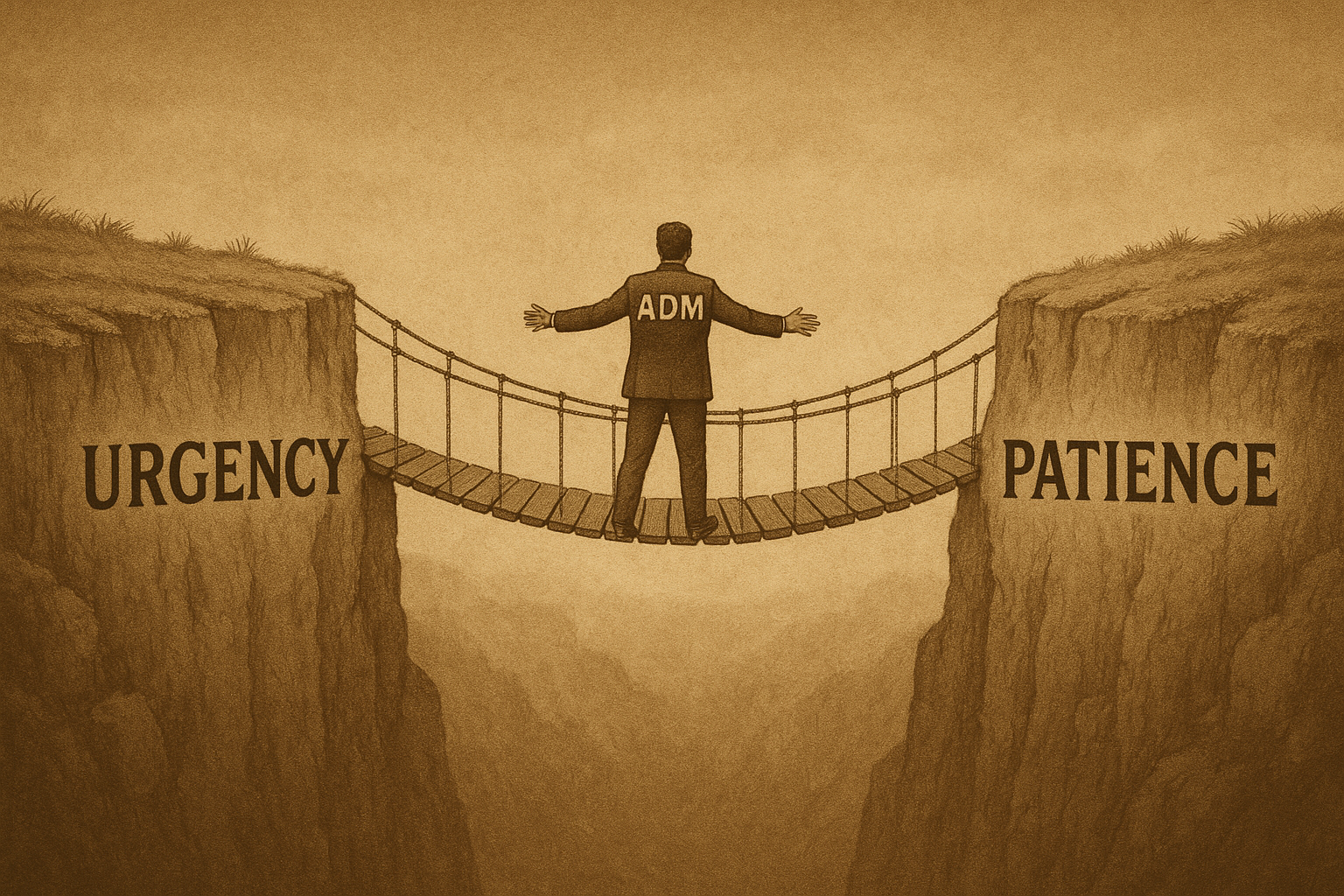
In transformation initiatives, ADMs are not just administrators; they are anchors who stabilize reform during turbulence. Their sponsorship role requires balancing urgency from above with patience required below, ensuring that political momentum is respected while organizational readiness is built.
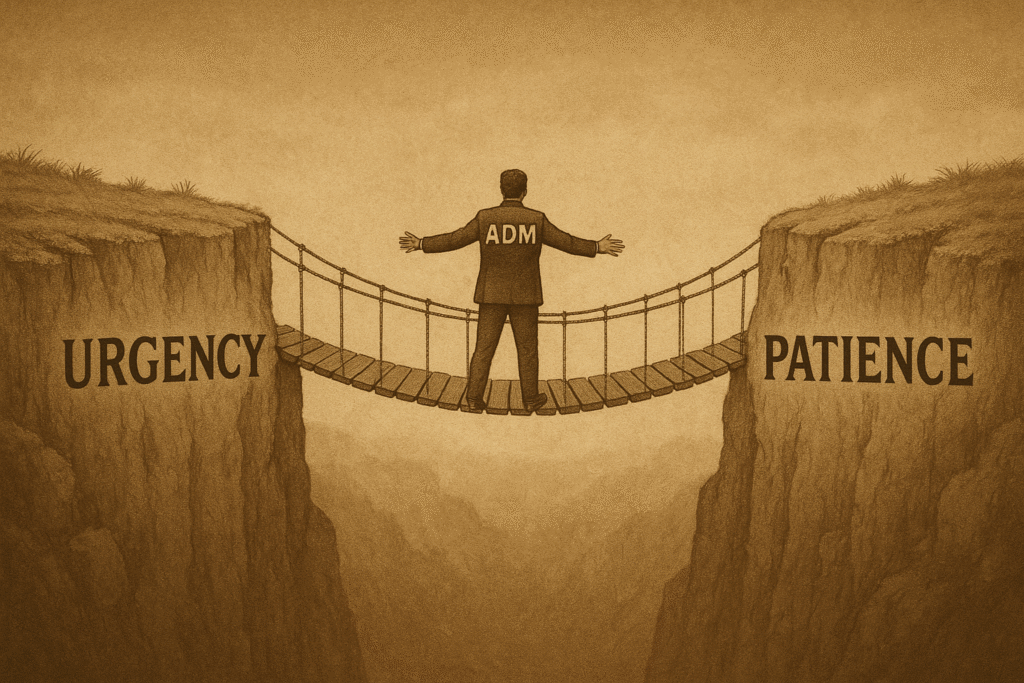
We explore how ADMs can strengthen their sponsorship capacity, bridging political ambition and operational execution while embodying both urgency and patience.
ADMs as Transformation Anchors
ADMs play a unique role in the sponsorship ecosystem:
- Vertical Integration: They link Ministers’ and DMs’ priorities with DGs’ delivery mechanisms.
- Horizontal Stewardship: They coordinate across silos, ensuring transformation efforts align with broader departmental and government objectives.
- Portfolio Stabilization: They shield their branches from political turbulence while still keeping reform moving forward.
As anchors, ADMs prevent reform initiatives from drifting or collapsing under competing pressures.
The Sponsorship Responsibility of ADMs
In practice, sponsorship at the ADM level includes:
- Clarifying Mandates
ADMs interpret transformation directives from Ministers and DMs, distilling them into achievable outcomes. They set expectations for DGs and Directors in ways that reconcile urgency with institutional patience. - Resource Alignment
They allocate budgets, staff, and tools to ensure transformation is properly resourced. Underfunded reforms erode credibility; ADMs must advocate for realistic commitments. - Change Championing
ADMs embody sponsorship by being visible advocates. Their presence at launch events, governance boards, and town halls signals to staff that transformation is a leadership priority (Kotter, 2012). - Risk Mediation
Transformation brings uncertainty. ADMs manage the tension between political appetite for rapid change and organizational risk tolerance, finding pragmatic ways to move forward without undermining institutional safeguards.
Urgency and Patience at the ADM Level
For ADMs, sponsorship is fundamentally about navigating paradoxes:
- Urgency:
- Meeting DM and Ministerial deadlines.
- Driving quick wins to demonstrate momentum.
- Keeping transformation visible to central agencies.
- Patience:
- Sequencing reforms to match organizational capacity.
- Allowing staff time to adapt to new processes.
- Building institutional trust through consistency and continuity.
ADMs must embody urgency upward and patience downward, serving as interpreters between political and operational realities (Heifetz, Grashow, & Linsky, 2009).
The Challenges of Sponsorship for ADMs
The ADM role is not easy. Sponsorship is complicated by:
- Competing Priorities: ADMs often oversee multiple files, making it difficult to sustain visible sponsorship for transformation.
- Central Agency Pressures: They must navigate Treasury Board, PCO, and Finance requirements that may delay reform even as Ministers demand speed (Savoie, 2008).
- Staff Capacity: DGs and Directors may resist change due to operational overload. ADMs must balance expectations with empathy.
- Political Turnover: Cabinet shuffles or changing ministerial priorities can destabilize initiatives, requiring ADMs to provide continuity.
Without deliberate attention, ADMs risk becoming reactive managers instead of proactive sponsors.
Practical Sponsorship Strategies for ADMs
1. Adopt a Dual-Speed Leadership Mindset
ADMs should communicate differently depending on their audience:
- Upward (to DMs and Ministers): Emphasize urgency, progress, and visible wins.
- Downward (to DGs and staff): Stress patience, process integrity, and long-term sustainability.
By holding both narratives, ADMs prevent staff from feeling crushed by urgency while ensuring Ministers perceive momentum.
2. Embed Sponsorship in Governance
Governance committees, portfolio boards, and oversight mechanisms are more than administrative requirements—they are sponsorship tools. ADMs can use these forums to:
- Reinforce priorities.
- Monitor progress without micromanaging.
- Demonstrate sustained visibility.
3. Practice Strategic Communication
ADMs must be visible and vocal. This includes:
- Speaking about transformation at all-hands meetings.
- Linking reform to broader public service values (e.g., service excellence, accountability).
- Modeling commitment through consistent messaging (Goleman, 2013).
4. Sequence for Sustainability
Transformation cannot be implemented in one leap. ADMs should sequence initiatives to deliver quick wins while laying groundwork for long-term reform. This ensures political appetite is met without overwhelming organizational endurance (Kotter, 2012).
5. Model Emotional Intelligence
Research shows that leaders who balance authority with empathy build greater trust and resilience during change (Goleman, 2013). ADMs can do this by:
- Acknowledging staff concerns.
- Celebrating incremental achievements.
- Remaining calm in the face of political urgency.
Case Example: ADM Sponsorship in Program Renewal
An ADM overseeing a major program renewal faced intense pressure from the Minister’s office to deliver visible results within a year. Staff, however, were fatigued after previous reforms.
The ADM balanced urgency and patience by:
- Urgency: Launching a targeted pilot initiative that delivered measurable service improvements in six months.
- Patience: Simultaneously introducing a phased capacity-building program, ensuring staff had the training and tools needed for sustained adoption.
This approach demonstrated progress to political leadership while protecting staff from unsustainable demands. The ADM’s visible sponsorship reinforced credibility, motivating both DGs and staff to stay engaged.
Risks of Weak ADM Sponsorship
If ADMs do not fulfill their sponsorship role, risks multiply:
- Transformation is deprioritized in the face of day-to-day crises.
- DGs and Directors lack clarity, creating fragmented efforts.
- Ministers and DMs perceive inertia, damaging trust.
- Staff disengagement grows, undermining momentum.
Weak sponsorship from ADMs is often cited as a leading cause of stalled reforms in the public sector (Savoie, 2008).
ADMs as Bridges Between Urgency and Patience
At their best, ADMs embody sponsorship by serving as bridges:
- Bridging political urgency and bureaucratic patience.
- Bridging strategic vision and operational execution.
- Bridging vertical leadership and horizontal collaboration.
By balancing these roles, ADMs become anchors of stability while enabling forward momentum.
External Support for ADM Sponsorship
ADMs can enhance their effectiveness through:
- Leadership coaching to strengthen adaptive capacity.
- Facilitated strategy sessions to align portfolios with ministerial priorities.
- Transformation frameworks and tools that provide consistency across branches.
External support helps ADMs avoid being consumed by operational firefighting, allowing them to focus on strategic sponsorship.
Conclusion: Sponsorship as Anchor Leadership
Assistant Deputy Ministers play a decisive role in transformation success. Positioned between political leadership and operational delivery, they anchor reform by balancing urgency and patience.
Through visible sponsorship, strategic communication, governance engagement, and emotional intelligence, ADMs can turn ambitious transformation agendas into achievable realities.
The sponsorship role is not about choosing urgency or patience—it is about holding both simultaneously, providing stability in turbulence, and ensuring that transformation takes root across the public service.
What’s Next?
Institute X partners with ADMs to strengthen their sponsorship role—providing coaching, facilitation, and structured frameworks to help them anchor transformation while balancing urgency with patience.
References
- Goleman, D. (2013). Focus: The Hidden Driver of Excellence. HarperCollins.
- Heifetz, R. A., Grashow, A., & Linsky, M. (2009). The Practice of Adaptive Leadership. Harvard Business Review Press.
- Kotter, J. (2012). Leading Change. Harvard Business Review Press.
- Savoie, D. J. (2008). Court Government and the Collapse of Accountability in Canada and the United Kingdom. University of Toronto Press.