
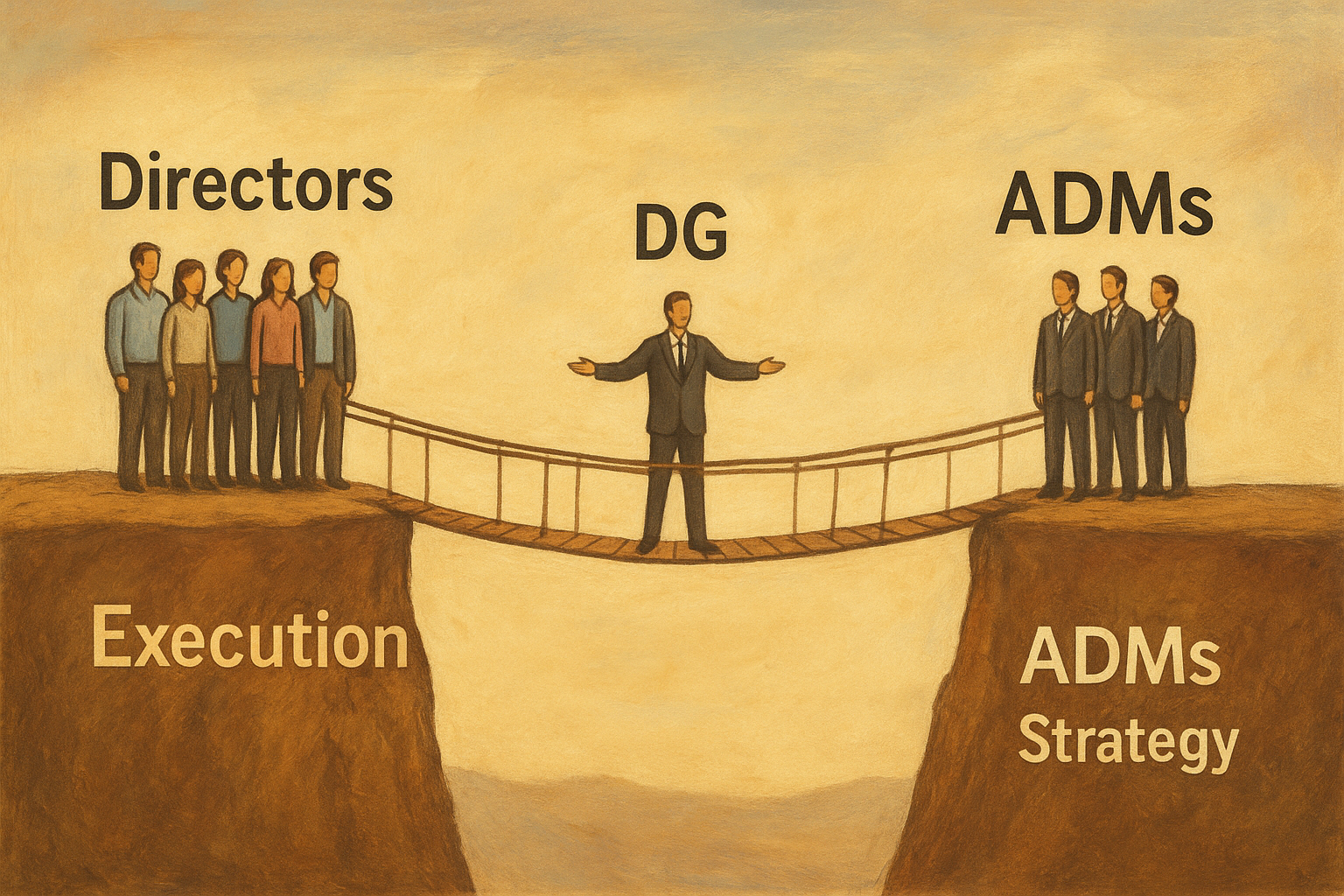
DGs as the Operational Backbone of Reform
Directors General (DGs) play a pivotal role in the federal government’s transformation journey. Positioned between Assistant Deputy Ministers (ADMs) and Directors, they are uniquely situated to translate strategic sponsorship into practical execution. While ADMs focus on embedding reforms across portfolios, DGs ensure that change reaches the ground level—shaping processes, systems, and cultures within their branches.

In many respects, DGs are the operational champions of transformation. They mobilize teams, sustain momentum, and overcome resistance to embed reforms into daily practice. This blog explores how DGs sustain transformation, the challenges they face, and the practices that distinguish successful DG sponsorship.
The DG Sponsorship Role: From Vision to Reality
DGs transform vision into reality through several core responsibilities:
- Operational Translation: They take departmental priorities and reframe them into actionable plans for their branches.
- Integration Across Functions: DGs manage complex portfolios that cut across programs, policy, and operations, requiring holistic leadership (Lindquist, 2006).
- Culture Carriers: DGs shape branch culture, modeling behaviours that reinforce transformation.
- Accountability Anchors: They are held accountable for measurable progress, making them central to sustaining reforms.
DGs are the leaders who ensure transformation is not just “announced” but actually felt by staff and citizens.
The Dual Challenge: Urgency and Patience at the DG Level
Like ADMs, DGs face the paradox of balancing urgency and patience—but with a more operational focus.
- Urgency:
- Staff expect direction and clarity.
- Ministers and ADMs need early evidence of reform in action.
- DGs must show quick progress to build credibility and trust.
- Patience:
- Deep organizational changes require years, not months.
- DGs must temper short-term pressures by pacing workloads, avoiding burnout, and reinforcing long-term priorities (Kotter, 2012).
- They must manage expectations carefully, ensuring reforms are sustainable.
This balance requires DGs to be both catalysts and stewards of transformation.
Sponsorship Responsibilities of DGs
- Communicate Consistently
- DGs reinforce the ADM’s narrative but adapt it to their branch.
- Communication must be frequent, clear, and grounded in branch realities.
- Mobilize Directors and Middle Managers
- Transformation succeeds when DGs activate Directors, who cascade reforms further down.
- DGs must empower managers while holding them accountable.
- Integrate Reforms into Daily Operations
- DGs ensure reforms are woven into processes, governance, and performance metrics.
- Without this operational integration, transformation risks being sidelined as “extra work.”
- Manage Resistance and Build Engagement
- Cultural resistance is strongest at the branch level.
- DGs must listen, coach, and model behaviours to bring staff along.
- Demonstrate Personal Sponsorship
- Staff closely watch whether DGs attend transformation meetings, reference reforms in speeches, or allocate branch resources.
- Visibility signals seriousness.
Challenges for DGs
- Competing Priorities
- DGs juggle operational crises, audits, and policy demands alongside transformation.
- Balancing these without losing reform momentum is a constant challenge.
- Resource Constraints
- Branch-level teams often feel “stretched thin.” DGs must advocate upward for resources while making tough allocation decisions.
- Change Fatigue
- Repeated waves of transformation can exhaust staff. DGs must pace reforms, celebrate wins, and highlight progress to maintain morale (McNulty & Ferlie, 2004).
- Middle-Management Bottlenecks
- Directors may resist or deprioritize reforms. DGs must break through these bottlenecks with coaching and accountability mechanisms.
Effective DG Sponsorship Practices
1. Embed Reform in Branch Governance
DGs who chair transformation committees or link reforms to existing governance forums normalize transformation as part of “business as usual.”
2. Model Visible Commitment
Attending key transformation workshops or personally presenting reform updates demonstrates leadership and seriousness.
3. Balance Quick Wins with Structural Change
- Quick wins (e.g., improved workflows, visible service improvements) generate momentum.
- Structural reforms (e.g., policy redesign, IT investments) anchor long-term change.
DGs must pursue both simultaneously.
4. Use Data to Demonstrate Progress
Regularly sharing metrics builds trust and accountability. DGs who rely on data rather than anecdotes strengthen credibility.
5. Develop Change Leaders
DGs sponsor not just projects but people—coaching Directors and managers to become transformation leaders in their own right.
Case Example: DG Sponsorship in Program Redesign
In one federal department, a DG was tasked with redesigning a legacy program to align with digital-first service delivery.
- Translation: The DG reframed ADM priorities into a branch-specific plan with clear timelines.
- Governance: A branch transformation committee chaired by the DG ensured alignment across units.
- Quick Wins: A pilot project digitizing one service line delivered early success.
- Structural Reform: Simultaneous investments in staff training and IT modernization laid a sustainable foundation.
- Visible Leadership: The DG attended weekly stand-ups, reinforcing personal sponsorship.
The program redesign not only improved service but also became a model replicated across other branches.
Risks of Weak DG Sponsorship
When DGs fail to sponsor transformation, risks emerge quickly:
- Fragmentation: Directors pursue unaligned initiatives.
- Low Morale: Staff disengage when leaders appear indifferent.
- Lost Momentum: Without DG advocacy, reforms lose traction and fade.
- Vulnerability: Projects collapse under political or operational pressure without branch-level ownership.
Research consistently shows that middle and senior leaders’ visible commitment is the most critical predictor of sustained change in public organizations (Fernandez & Rainey, 2006).
Supporting DG-Level Sponsorship
Organizations can strengthen DG sponsorship by:
- Providing Coaching and Peer Networks: DGs benefit from spaces to share challenges and strategies.
- Resourcing Change Teams: Dedicated project offices help DGs sustain reforms.
- Recognition Programs: Highlighting DG-led transformation successes reinforces the desired behaviours.
- Aligning Performance Metrics: Embedding transformation outcomes into DG performance agreements anchors accountability.
Conclusion: DGs as the Operational Champions of Transformation
DGs are the operational champions of federal transformation. They translate ADM sponsorship into branch-level execution, integrate reforms into daily operations, and sustain momentum over time. Their visibility, persistence, and ability to balance urgency with patience determine whether transformation sticks or slips away.
Strong DG sponsorship ensures that reforms endure beyond announcements, surviving political shifts and operational crises. In short, DGs make transformation real.
What’s Next?
Institute X works with Directors General to strengthen sponsorship practices, building capacity to embed transformation across branches and sustain reforms through political and operational turbulence.
References
- Fernandez, S., & Rainey, H. G. (2006). Managing successful organizational change in the public sector. Public Administration Review, 66(2), 168–176.
- Kotter, J. (2012). Leading Change. Harvard Business Review Press.
- Lindquist, E. (2006). Organizing for Policy Implementation in Canada: The Changing Federal Context. McGill-Queen’s University Press.
- McNulty, T., & Ferlie, E. (2004). Process Transformation: Limitations to Radical Organizational Change within Public Service Organizations. Organization Studies, 25(8), 1389–1412.