
Beyond Technology — Leading Cultural Change
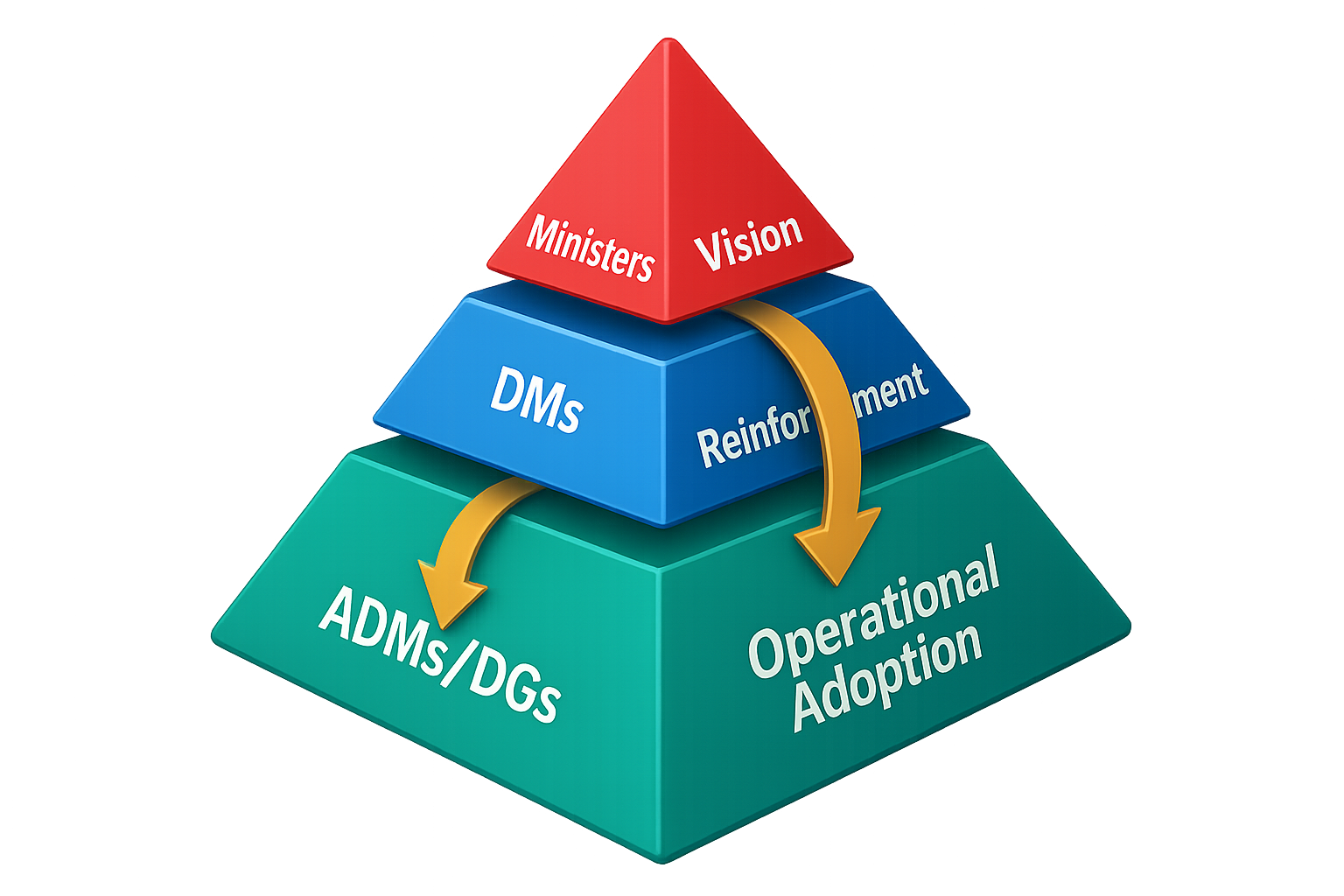
Digital transformation in government is not only a technological challenge but also a cultural one. Ministers and Deputy Ministers (DMs) are responsible for embedding new ways of working across departments, ensuring that staff adopt digital tools and processes while aligning with broader political priorities.
Cultural transformation is critical because even well-designed systems fail if employees resist or misunderstand new approaches. Ministers provide political sponsorship and messaging, while DMs operationalize cultural shifts through governance, resources, and engagement. Together, they set the tone for innovation, adaptability, and performance excellence.
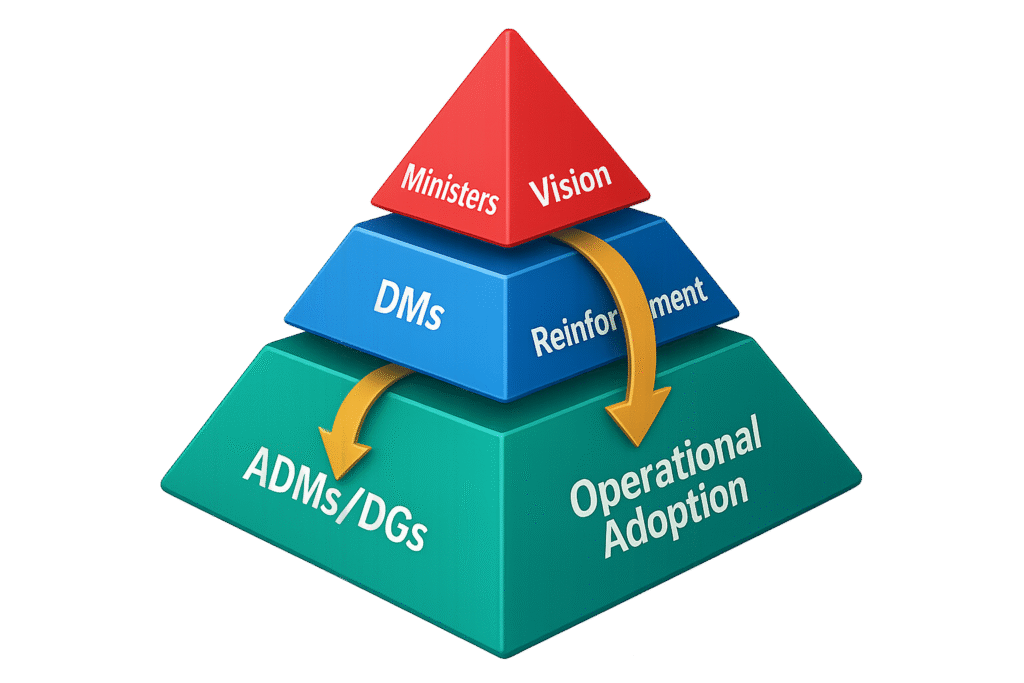
This blog explores how Ministers and DMs can lead cultural change effectively, integrating it with strategic objectives and operational execution.
The Apex Role in Cultural Transformation
Ministers: Champions of Culture
- Framing the Narrative: Ministers articulate why cultural change matters to citizens, Parliament, and staff, emphasizing the benefits of digital adoption and service improvement.
- Visible Advocacy: Ministers must publicly support initiatives, attend milestone events, and highlight successes to reinforce the importance of transformation.
- Resource Allocation: Ministers ensure sufficient funding for training, leadership development, and communications campaigns that support culture change.
Deputy Ministers: Operationalizing Culture
- Embedding Values: DMs ensure that departmental values support digital adoption, experimentation, and collaboration.
- Coaching ADMs and DGs: They guide mid-level leaders in fostering culture at the directorate level, helping staff internalize new behaviors.
- Governance Alignment: DMs integrate culture change into performance frameworks, operational metrics, and accountability structures (Savoie, 2003).
By aligning political messaging with operational reinforcement, Ministers and DMs can create a sustainable cultural shift that supports digital and organizational transformation.
Key Challenges
- Legacy Mindsets and Resistance
- Staff accustomed to traditional workflows may resist change. Ministers’ advocacy and DMs’ operational reinforcement are required to overcome inertia.
- Political Cycles and Continuity
- Ministers may rotate or face electoral pressures, potentially disrupting momentum. DMs maintain continuity and ensure cultural initiatives survive changes in leadership.
- Balancing Innovation with Accountability
- Ministers push for rapid change to demonstrate results, while DMs must ensure compliance, risk management, and service continuity.
- Interdepartmental Coordination
- Cultural transformation often spans multiple branches; Ministers negotiate political alignment, and DMs operationalize consistency.
- Measuring Cultural Change
- Unlike project milestones, culture is intangible and requires qualitative and quantitative measures such as engagement surveys, adoption metrics, and staff feedback loops (Kotter, 2012).
Strategies for Ministers and DMs
- Visible, Sustained Sponsorship
- Ministers must actively champion cultural change initiatives in public and internal forums.
- DMs reinforce messaging through operational decisions, performance metrics, and recognition programs.
- Integrate Culture into Performance Management
- Tie cultural objectives to KPIs and performance agreements at all levels.
- Recognize staff and leadership behaviors that align with transformation priorities.
- Early Wins and Pilot Programs
- Launch small-scale initiatives to demonstrate the benefits of new practices. Early successes build credibility and reduce resistance.
- Communication at Scale
- Use multi-channel communications to ensure consistent messaging.
- Ministers and DMs should co-author communications, including speeches, memos, and departmental newsletters.
- Leadership Development and Coaching
- Invest in ADMs and DGs through coaching, mentoring, and workshops.
- Equip mid-level leaders to model desired behaviors and guide teams through transition.
Case Example: Modernizing Citizen Services through Cultural Change
A federal initiative to digitize citizen applications illustrates successful cultural transformation:
- Ministerial Role: Framed the transformation as a “citizen-first” initiative, highlighting benefits to the public and engaging media to promote adoption.
- DM Role: Established departmental governance, set performance expectations, and coached ADMs on cultural messaging.
- ADM Role: Coordinated directorates to ensure adoption and provided support for operational challenges.
- DG Role: Led teams in adopting new tools, coaching staff, and tracking usage metrics.
Outcome: 60% of targeted staff adopted new digital tools within the first six months, service satisfaction improved, and departmental KPIs were exceeded. The combination of political advocacy and operational reinforcement was critical to this success.
Risks of Weak Cultural Leadership
Without Minister and DM sponsorship:
- Low Staff Engagement: Initiatives may be ignored or superficially adopted.
- Fragmented Implementation: Different branches pursue inconsistent approaches.
- Reduced Political Credibility: Ministers cannot demonstrate tangible outcomes.
- Missed Long-Term Opportunities: Departments fail to sustain innovation beyond initial project phases.
Empirical research emphasizes the importance of top-level sponsorship in driving cultural change, particularly in complex public sector environments (Fernandez & Rainey, 2006; Kotter, 2012).
Supporting Ministers and DMs
To reinforce cultural transformation, organizations can:
- Develop Alignment Workshops: Align Ministers, DMs, and ADMs on goals, messaging, and milestones.
- Invest in Leadership Programs: Coaching for ADMs and DGs on change management and digital leadership.
- Implement Metrics for Culture: Use surveys, adoption metrics, and performance dashboards to monitor progress.
- Encourage Cross-Department Collaboration: Facilitate networks and communities of practice to share lessons learned.
Conclusion
Ministers and DMs are strategic and operational anchors for cultural change. Ministers provide visibility, political support, and advocacy, while DMs operationalize culture through governance, coaching, and performance frameworks. Their alignment ensures transformation initiatives are sustainable, staff engagement is high, and political and operational outcomes are achieved.
Strong leadership at the apex not only supports digital transformation but also strengthens the organizational culture, embedding innovation, accountability, and adaptability across departments.
What’s Next?
Institute X partners with Ministers and DMs to provide independent guidance, leadership coaching, and governance frameworks that embed cultural transformation for sustainable change.
References:
- Fernandez, S., & Rainey, H. G. (2006). Managing successful organizational change in the public sector. Public Administration Review, 66(2), 168–176.
- Kotter, J. P. (2012). Leading Change. Harvard Business Review Press.
- Savoie, D. J. (2003). Breaking the Bargain: Public Servants, Ministers, and Parliament. University of Toronto Press.