
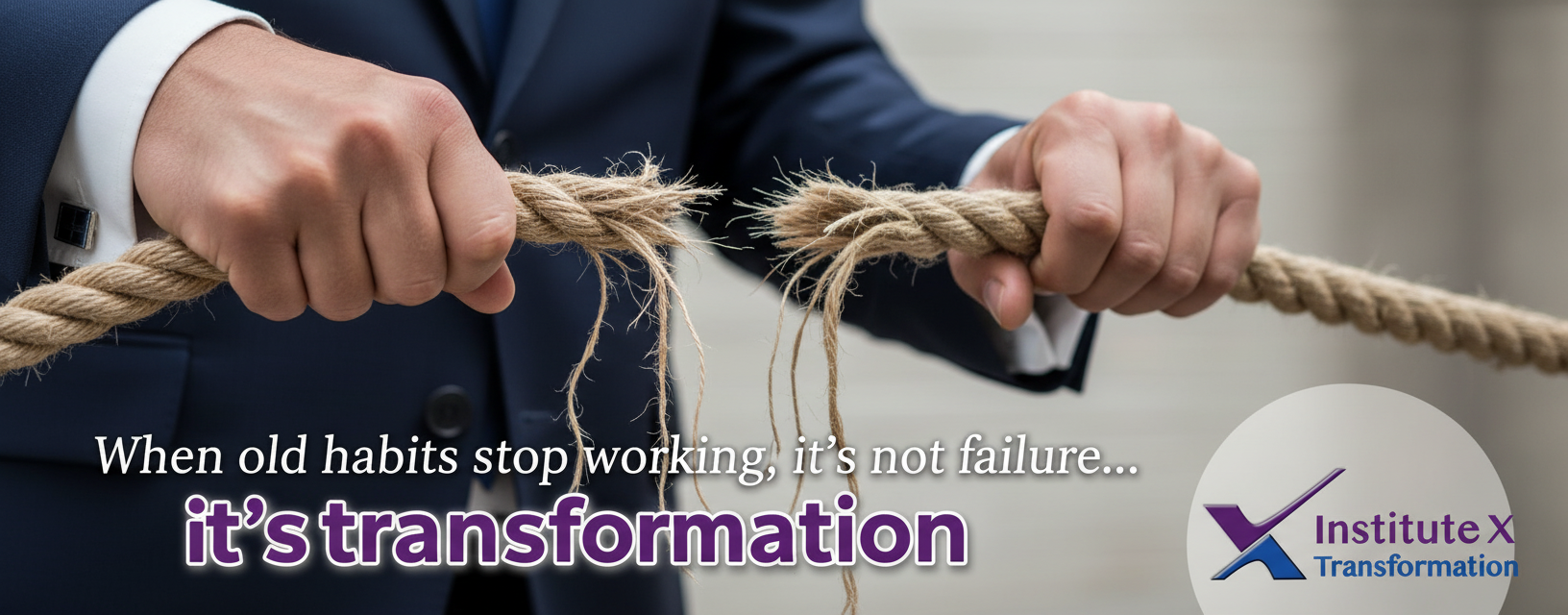
Why Old Habits Fail in Transformational Leadership
One of the hardest moments for an experienced executive isn’t the steep learning curve of a first job. It’s the sudden realization, often years into a career, that the habits and instincts that carried them this far no longer seem to work. The reliable methods—the quick reading of a room, the sharp negotiation strategy, the crisp problem-solving shortcut—lose their punch.
This moment often comes when leaders are tasked with transformational assignments: complex, ambiguous initiatives that demand change at scale. Whether it’s implementing a digital overhaul of federal services, integrating a merger, or leading a major policy shift, the rules of the game change. What was once mastery can suddenly feel like clumsiness. For leaders who’ve built an identity around competence, this is profoundly unsettling.
Why Old Patterns Fail
The failure of familiar strategies in transformational contexts isn’t a flaw in the leader; it’s a feature of the work. Transformational assignments differ from routine operations in several critical ways.
- Complexity Overwhelms Linear Thinking
Transformations are rarely bounded problems. As Heifetz (1994) observed, adaptive challenges cannot be solved by applying technical expertise. Instead, they demand experimentation, iteration, and the mobilization of people across the system. Old methods designed for technical fixes fall short. - New Context, New Culture
As Herminia Ibarra (2015) explains, when leaders move into new contexts, their established identity scripts often clash with what the environment requires. Leaders who were effective in one organizational culture may find that style backfires in another—particularly during a transformation, where resistance to change is high. - Visibility Magnifies Every Misstep
Transformational mandates come with scrutiny. Ministers, boards, media, or unions watch closely. Even effective habits may appear inadequate under amplified expectations. This visibility alone can make once-trusted strategies feel suddenly unreliable.
The Experience of “Losing Facility”
Leaders often describe this shift as a loss of facility—the ease with which decisions once came. Daniel Kahneman (2011) provides insight: in uncertain environments, our brains are forced out of “System 1” fast thinking and into “System 2” slow thinking. What feels like clumsiness is in fact a more deliberate, effortful cognitive process.
But to leaders who have built careers on decisiveness, that shift feels like erosion of competence. The problem isn’t actual decline—it’s the mismatch between expectations of fluency and the reality of necessary effort.
Robert Kegan and Lisa Lahey (2009) frame this as an immunity to change: subconscious commitments and habits that once protected performance may now block growth. To move forward, leaders must surface and examine those hidden commitments.
The Risk of Clinging to the Old
When leaders feel facility slipping, the instinct is often to double down on what worked before. This can be dangerous.
- Rigid application of old methods can alienate stakeholders who need something different.
- Defensive overconfidence can blind leaders to warning signals.
- Withdrawal into self-doubt can paralyze decision-making.
Edgar Schein (2013) notes that in complex settings, leaders must learn to ask rather than tell, creating space for others’ expertise. Those who cling to command-and-control habits may project confidence, but risk leading the organization off course.
The critical shift is reframing loss of facility not as decline but as a natural part of growth. Leaders are not becoming less capable—they are being stretched into a new dimension of leadership.
- From answers to questions: Moving from being the source of solutions to the facilitator of collective problem-solving.
- From control to influence: Shifting from direct command to shaping context and culture.
- From speed to steadiness: Replacing quick wins with the patience to navigate systemic change.
Brené Brown (2018) reminds us that courage is not about pretending certainty but about showing up when the outcome is unclear. That’s the essence of transformational leadership.
The Role of Support
If leaders can’t simply lean on their old habits, where do they turn? The answer is not “go it alone.”
As Douglas Riddle of the Center for Creative Leadership emphasizes, coaching provides a structured environment where leaders can test assumptions, explore new strategies, and accelerate learning (Conference Board, 2016). The value lies in:
- Neutral perspective: A partner outside organizational politics who can challenge without agenda.
- Reflective space: A rare setting for leaders to process self-doubt and surface new insights.
- Adaptive skill-building: Focused development of the mindsets required for transformational work.
This is not about discarding everything learned before. It is about integrating past strengths with new approaches tailored to transformational complexity.
Thriving in the New Mandate
Leaders who succeed in transformational contexts share one common trait: they embrace the temporary discomfort of losing facility as the price of growth. They recognize that their authority lies not in clinging to past methods but in navigating uncertainty with grounded confidence.
This means acknowledging that old habits may fail—and that’s not evidence of weakness. It is the necessary turbulence of stretching into the kind of leadership the moment demands.
The Institute X Coaching Option
If your go-to strategies no longer seem to land, don’t mistake that for failure. It’s a signal you’re working in transformational territory—and the right ally can help you adapt faster, regain confidence, and lead with the steady hand your mandate demands.
Institute X is a transformation leadership consultancy and transformation/change leader coaching firm. One of its online presences is The Change Playbook. Be sure to check out the abundance of practical and pragmatic guidance. Subscribe to be notified of new, fresh content.
References
Brown, B. (2018). Dare to lead: Brave work. Tough conversations. Whole hearts. Random House.
Heifetz, R. A. (1994). Leadership without easy answers. Harvard University Press.
Ibarra, H. (2015). Act like a leader, think like a leader. Harvard Business Review Press.
Kahneman, D. (2011). Thinking, fast and slow. Farrar, Straus and Giroux.
Kegan, R., & Lahey, L. L. (2009). Immunity to change: How to overcome it and unlock the potential in yourself and your organization. Harvard Business Press.
Riddle, D. (2016). Quoted in The Conference Board. Coaching: A global study of successful practices. The Conference Board.
Schein, E. H. (2013). Humble inquiry: The gentle art of asking instead of telling. Berrett-Koehler Publishers.