
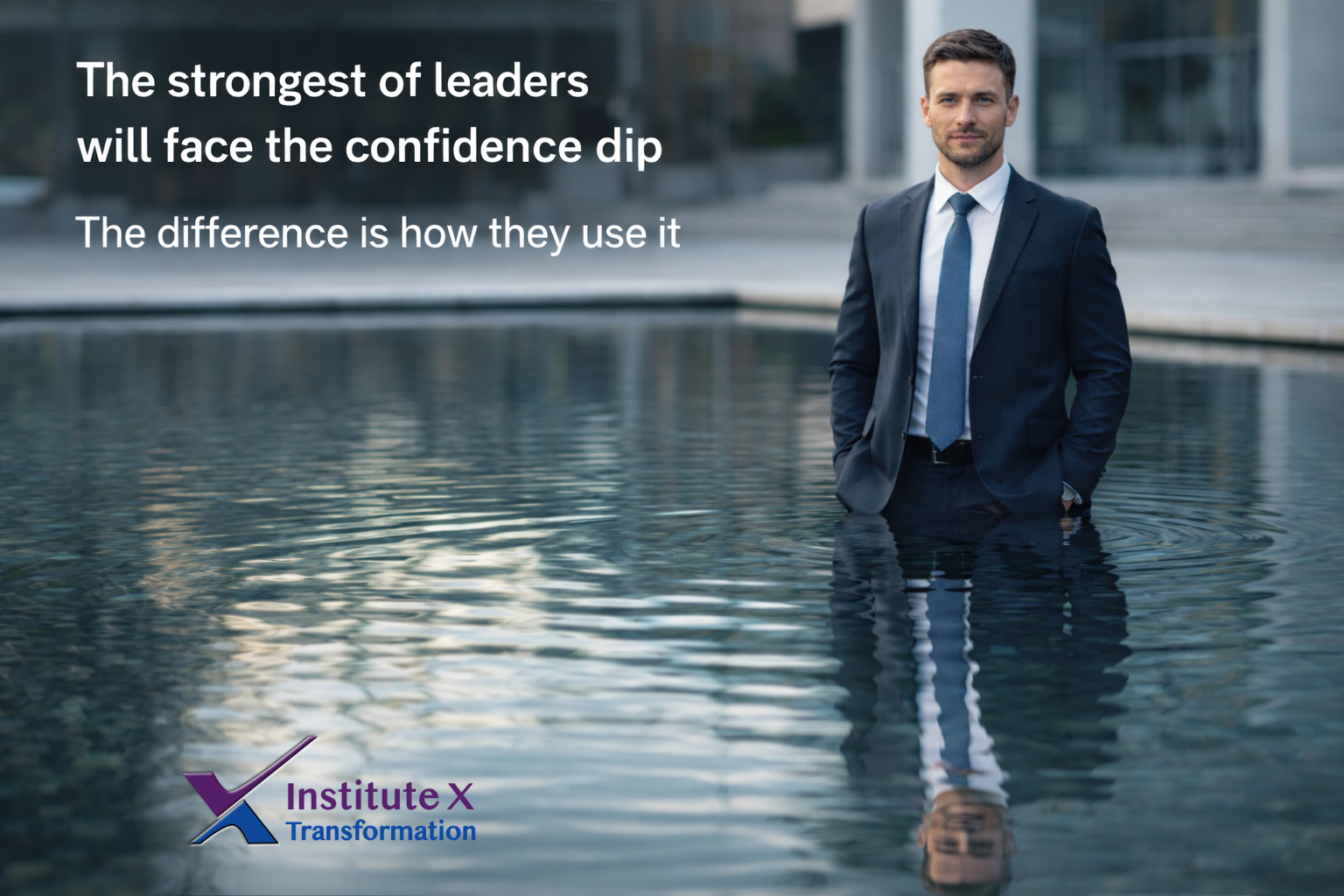
Why Strong Leaders Doubt Themselves in Transformation
For many senior executives, confidence is not optional—it’s the currency of leadership. Staff, boards, or ministers look to you for steadiness, especially when the path ahead is unclear. Yet even the most capable leaders experience a dip in confidence when they take on transformational mandates.
This isn’t weakness. It’s not even unusual. It is a natural byproduct of leading in high-stakes, ambiguous contexts. The very situations that demand the most from a leader are also those most likely to undercut their sense of ease and certainty.
Why Confidence Slips During Transformations
Transformational assignments—digitizing government services, driving large-scale organizational restructuring, pivoting a business in response to disruption—have three qualities that erode even seasoned leaders’ confidence:
- Ambiguity and Novelty
In routine contexts, confidence comes from experience: having solved similar problems before. Transformational challenges, by contrast, are often without precedent. Daniel Kahneman (2011) explains that ambiguity forces the brain to abandon quick, intuitive “System 1” judgments and shift into effortful, slower “System 2” reasoning. That cognitive drag feels like hesitation, which leaders interpret as loss of confidence. - Visibility and Pressure
High-stakes change rarely happens in the shadows. Federal executives contend with parliamentary committees, media scrutiny, and union stakeholders. Commercial leaders face shareholder expectations, regulators, or customers. The weight of visibility magnifies mistakes and makes uncertainty feel riskier than it is. - Loss of Familiar Facility
As Herminia Ibarra (2015) argues, stepping into new leadership territory destabilizes established identity. Behaviours that once delivered consistent results suddenly don’t. This mismatch between “who I was” and “what the situation requires” fuels doubt.
The Normalcy of Doubt
Self-doubt in transformation is not evidence of incompetence—it’s evidence of stretch. Ronald Heifetz (1994) notes that adaptive challenges cannot be met with technical expertise alone; they require experimentation, discovery, and mobilizing others. That process inevitably feels messy.
Research by Zenger and Folkman (2019) confirms that leaders in transition commonly underestimate their effectiveness compared to how others rate them. In other words, a confidence dip is often psychological, not performance-based. The leader feels off balance, even when their impact remains strong.
The Dangers of Mismanaging Self-Doubt
Left unchecked, self-doubt can drive unproductive behaviours:
- Overcompensation through arrogance — projecting false certainty, shutting down dissent, and clinging rigidly to decisions.
- Excessive caution — avoiding risk, delaying decisions, or trying to secure consensus to the point of paralysis.
- Withdrawal — isolating from peers or staff, which creates a vacuum of leadership just when visibility is most critical.
Edgar Schein (2013) warns against leaders defaulting to “telling” in moments of insecurity, when humility and inquiry are more productive. Mismanaged doubt not only undermines the leader’s own confidence but destabilizes the broader organization.
Harnessing Doubt as a Leadership Asset
The alternative is to harness doubt. Properly framed, self-doubt becomes a powerful leadership resource:
- Catalyst for learning: Doubt motivates leaders to test assumptions, seek diverse perspectives, and avoid complacency.
- Check against hubris: It tempers overconfidence and keeps decision-making grounded.
- Signal of growth: Brené Brown (2018) reminds us that vulnerability—acknowledging uncertainty—is the foundation of courageous leadership.
Robert Kegan and Lisa Lahey (2009) go further, arguing that surfacing hidden assumptions is the very work of personal and organizational transformation. Leaders who treat doubt as data, not deficiency, grow faster and more sustainably.
The Role of Trusted Support
No leader should face this confidence dip alone. Yet organizations often expect executives to “just know” how to carry transformational mandates. The reality is that leaders need space and partnership to process the turbulence.
Douglas Riddle (Conference Board, 2016) describes coaching as helping leaders “face reality, see possibilities, and take action that accelerates their effectiveness.” For executives navigating a confidence dip, that partnership is invaluable. A trusted ally provides:
- Perspective — distinguishing between real performance issues and normal turbulence.
- Challenge — pushing leaders to see beyond their immediate assumptions.
- Safe rehearsal — a space to explore ideas without political or reputational risk.
- Acceleration — shortening the length of the confidence dip so leaders regain steadiness sooner.
Thriving Through the Dip
The confidence dip is not something to be avoided—it is something to be managed. Leaders who normalize and harness doubt emerge stronger, more adaptive, and more credible. Their confidence is not the brittle certainty of “always knowing,” but the grounded assurance that they can learn, adapt, and keep leading forward.
For leaders in the Canadian federal government, where transformational mandates are accelerating in scope and scale, the ability to lead confidently through uncertainty will be decisive. The same is true for private-sector executives navigating disruption. The question is not whether confidence will dip—it will—but whether leaders are equipped to recover stronger on the other side.
The Institute X Coaching Option
If you’re leading a transformation and feel your confidence slipping, recognize that as the normal turbulence of growth. The right partner can help you steady quickly, harness doubt as fuel, and turn a fragile moment into the foundation of stronger leadership.
Institute X is a transformation leadership consultancy and transformation/change leader coaching firm. One of its online presences is The Change Playbook. Be sure to check out the abundance of practical and pragmatic guidance. Subscribe to be notified of new, fresh content.
References
Brown, B. (2018). Dare to lead: Brave work. Tough conversations. Whole hearts. Random House.
Heifetz, R. A. (1994). Leadership without easy answers. Harvard University Press.
Ibarra, H. (2015). Act like a leader, think like a leader. Harvard Business Review Press.
Kahneman, D. (2011). Thinking, fast and slow. Farrar, Straus and Giroux.
Kegan, R., & Lahey, L. L. (2009). Immunity to change: How to overcome it and unlock the potential in yourself and your organization. Harvard Business Press.
Riddle, D. (2016). Quoted in The Conference Board. Coaching: A global study of successful practices. The Conference Board.
Schein, E. H. (2013). Humble inquiry: The gentle art of asking instead of telling. Berrett-Koehler Publishers.
Zenger, J., & Folkman, J. (2019). The trickiest part of a promotion is the first few months. Harvard Business Review.