
Sustaining Energy in Prolonged Transformation
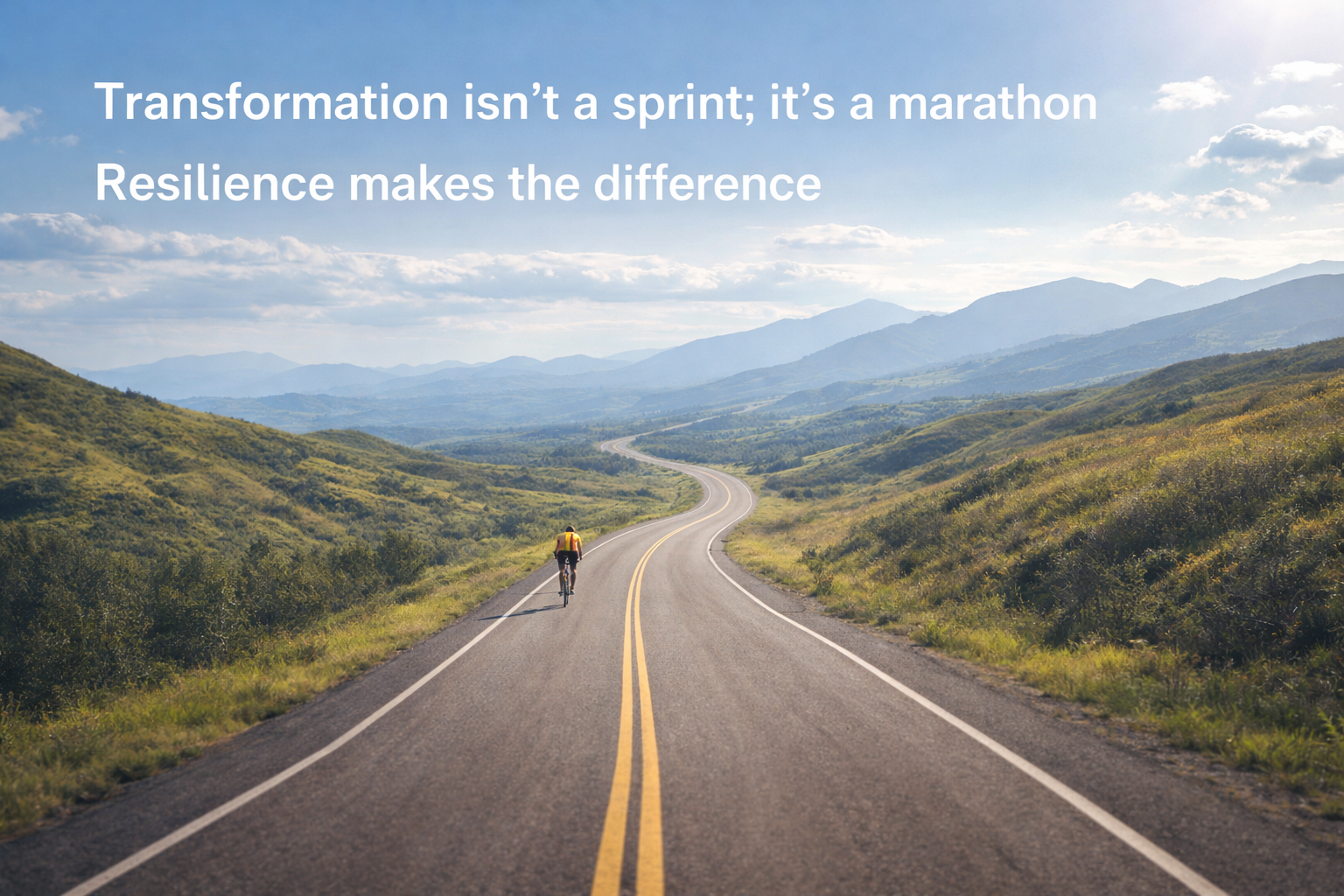
Transformation is not a sprint. For senior executives, the initial burst of urgency and focus can give way to long months—or years—of uncertainty, political friction, and relentless demands. What begins as a high-profile mandate to “fix” or “modernize” soon becomes a test of endurance: keeping yourself, your team, and the wider organization energized through setbacks, slow progress, and constant scrutiny.
Resilience in this context is not about stoically absorbing blows until collapse. Nor is it simply “grit.” True executive resilience is the disciplined practice of sustaining energy, perspective, and effectiveness over time—without burning out or eroding the trust of those you lead.
Why Transformation Tests Resilience
Large-scale transformation is uniquely draining because:
- Timelines stretch: Projects often last far longer than initial estimates, and early wins may be hard to secure.
- Resistance accumulates: Initial enthusiasm meets entrenched interests, cultural inertia, or regulatory constraints.
- Visibility magnifies pressure: Senior leaders are constantly under the microscope—by boards, ministers, media, or employees—making every stumble feel amplified.
- Resources strain: Competing priorities and limited capacity create chronic tension between ambition and feasibility.
Scholars such as Robert Kegan and Lisa Lahey (2009) describe transformational change as a direct challenge to mental and organizational “immunity to change.” Leaders face the paradox of driving change while also being subject to the same forces of fatigue and resistance as their teams.
Common Failure Modes
Executives under prolonged strain often fall into predictable traps:
- Heroics that burn out: Leaders overextend themselves, sacrificing rest and reflection until they are depleted.
- Withdrawal: Some retreat into defensive routines, avoiding conflict and letting momentum stall.
- Cynicism: Persistent obstacles can breed disengagement, signalling to others that the transformation is doomed.
Research by Christina Maslach and Michael Leiter (2016) on burnout underscores that depletion is not an individual weakness but a structural risk in high-demand, low-control, low-support environments. Transformation, unfortunately, often creates exactly those conditions.
Elements of Sustainable Resilience
- Energy Management, Not Just Time Management
Tony Schwartz and Jim Loehr (2003) argue that leaders must manage energy across physical, emotional, mental, and spiritual dimensions. Transformation requires peak performance, but also deliberate renewal. - Adaptive Mindset
Carol Dweck’s (2006) work on growth mindset shows the value of framing setbacks as learning opportunities rather than evidence of inadequacy. Leaders who model adaptive learning help organizations persist through turbulence. - Support Systems
Studies of executive effectiveness consistently emphasize the protective role of confidential support networks—mentors, peers, or coaches—who provide both perspective and challenge (Sherman & Freas, 2004). - Purpose and Values Alignment
Linking daily grind to broader purpose sustains meaning. Viktor Frankl (2006) observed that meaning, not comfort, enables people to endure hardship. Executives who articulate the “why” of transformation repeatedly re-anchor resilience for themselves and their teams.
Practical Habits for Leaders
- Protect restorative time: Guard sleep, exercise, and reflection as fiercely as any meeting.
- Normalize human limits: Signal to teams that pacing, not only pushing, is part of sustainable performance.
- Celebrate progress: Marking milestones, even small ones, counters fatigue and reinforces momentum.
- Invest in coaching or peer dialogue: Structured reflection prevents blind spots and combats isolation.
- Reframe setbacks: Treat delays or obstacles as data, not verdicts, reinforcing a culture of adaptive learning.
Executive Coaching and Resilience
The longer the transformation, the more a leader’s resilience is tested. Executive coaching strengthens resilience by:
- Creating a safe, structured space to process setbacks without undermining organizational credibility.
- Helping leaders identify unsustainable patterns (e.g., overextension, avoidance) before they calcify.
- Equipping leaders with practices for sustained presence and energy renewal.
- Providing accountability to balance urgency with endurance.
As Richard Boyatzis and Annie McKee (2005) highlight, emotionally intelligent leaders who manage their energy and model optimism can create “resonance” that sustains collective resilience—even in prolonged challenge.
The Payoff
Executives who master resilience under pressure create organizations capable of sustaining transformation beyond initial enthusiasm. They embody steadiness and perspective, keeping the mission alive when others falter.
Resilience is not a luxury—it is a core leadership competency for transformation. Without it, even the most brilliant strategy collapses under the weight of fatigue. With it, leaders can navigate the marathon of change with strength, clarity, and integrity.
The Institute X Coaching Option
If transformation feels less like a sprint and more like an unending marathon, you are not alone—and you don’t need to run it without support. Resilience can be cultivated, and the right coaching can help you sustain energy, clarity, and presence for the long game of transformational leadership.
Institute X is a transformation leadership consultancy and transformation/change leader coaching firm. One of its online presences is The Change Playbook. Be sure to check out the abundance of practical and pragmatic guidance. Subscribe to be notified of new, fresh content.
References
Boyatzis, R., & McKee, A. (2005). Resonant leadership: Renewing yourself and connecting with others through mindfulness, hope, and compassion. Harvard Business Review Press.
Dweck, C. S. (2006). Mindset: The new psychology of success. Random House.
Frankl, V. E. (2006). Man’s search for meaning. Beacon Press.
Kegan, R., & Lahey, L. L. (2009). Immunity to change: How to overcome it and unlock the potential in yourself and your organization. Harvard Business Press.
Loehr, J., & Schwartz, T. (2003). The power of full engagement. Free Press.
Maslach, C., & Leiter, M. (2016). [Burnout: A multidimensional perspective. In C. Maslach & M. P. Leiter (Eds.), Stress and burnout: Critical concepts in psychology (Vol. 2).] Routledge.
Sherman, S., & Freas, A. (2004). The wild west of executive coaching. Harvard Business Review.