
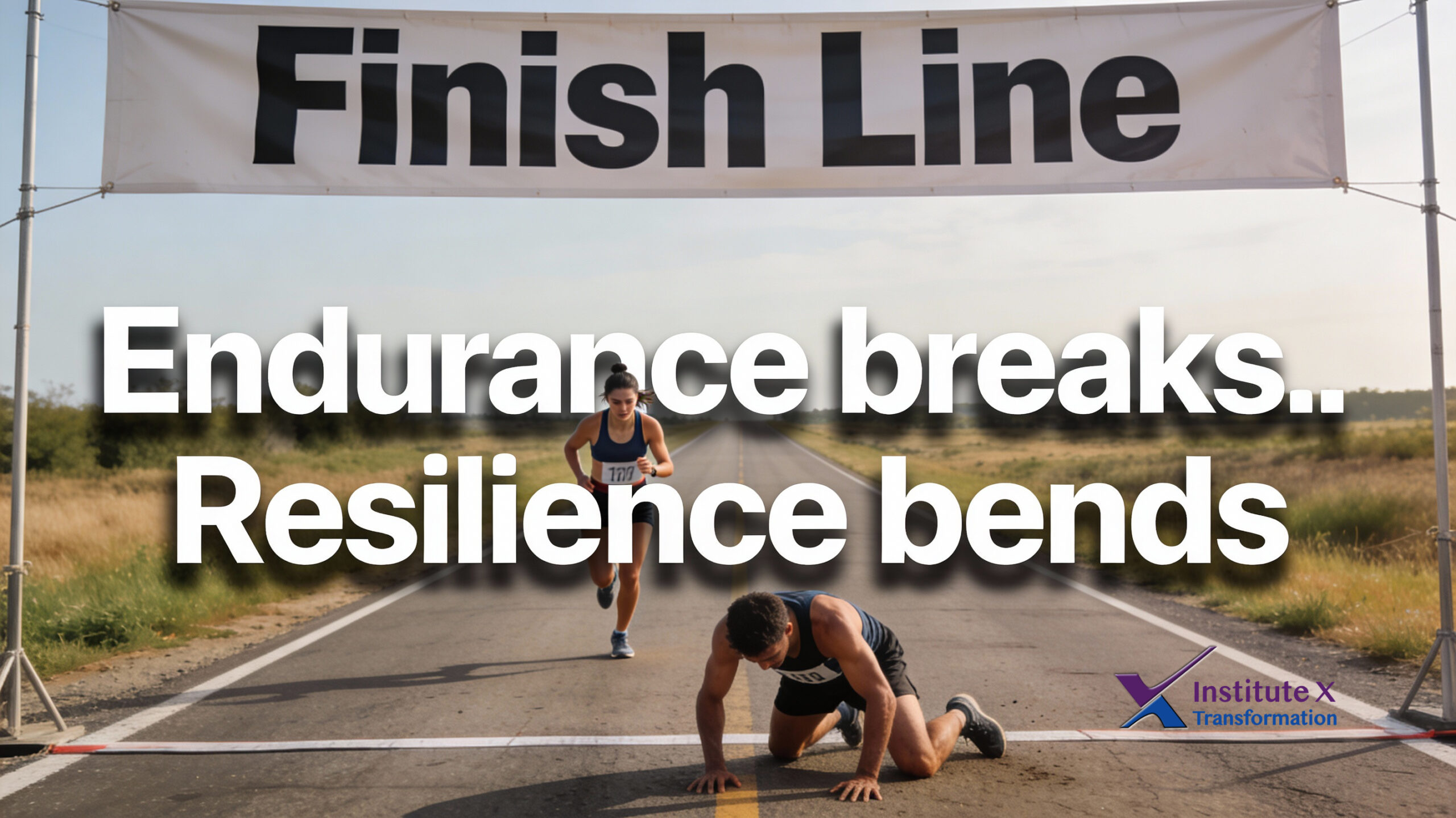
The Misunderstood Demands of Transformation
In the world of high-stakes leadership, resilience is a term that often gets invoked but rarely understood. Too often, it is confused with endurance—the ability to push through difficulty by sheer force of will, grit, or stamina. While endurance has its place, it is not resilience. And in the face of transformational change, conflating the two can derail both leaders and organizations.
Endurance is about persisting at all costs, even when circumstances demand adaptation. Resilience, by contrast, is about recovering, rebalancing, and recalibrating so that persistence is sustainable. Leaders who lean solely on endurance often burn out or lead their teams into exhaustion. Leaders who practice resilience, however, model adaptability and create the conditions for long-term success.
Endurance: Strength That Turns Fragile
Endurance can be seductive. It projects toughness, signals commitment, and satisfies cultural expectations of stoic leadership. In Canada’s federal government—and in many large organizations—leaders who “grind it out” are often admired for their stamina and capacity to take on more.
But endurance has hidden costs:
- Rigidity: Endurance focuses on survival, not learning. Leaders persist even when tactics need to change.
- Exhaustion: Endurance depletes resources without replenishment, leading to burnout.
- Blindness to context: Endurance can cause leaders to mistake effort for impact, ignoring whether their approach is effective.
As McEwen and Stellar (1993) note in their work on stress physiology, chronic stress without recovery degrades performance and health. The same holds true for leadership: sustained pressure without adaptation leads to breakdown, not breakthrough.
Resilience: Adaptation in Action
Resilience is not about toughness but flexibility. It is the capacity to rebound from disruption, integrate lessons, and continue forward with renewed focus. In transformation—where uncertainty and ambiguity are constant—resilience is far more valuable than brute stamina.
Key dimensions of resilience include:
- Recovery: Recognizing the need to pause, reset, and re-engage with clarity.
- Learning: Using disruption as fuel for reflection and adjustment.
- Connection: Drawing strength from networks of trust and collaboration.
- Purpose anchoring: Maintaining direction even when tactics must shift.
Psychologist Ann Masten (2001) famously described resilience as “ordinary magic”: a set of everyday processes that help people adapt in the face of adversity. For executives, that magic lies in cultivating habits of reflection, openness, and recalibration—rather than simply grinding harder.
Why Resilience Matters More in Transformation
Transformation is not a sprint, and it is not even a marathon. It is more like a series of unpredictable terrain shifts, where the ground moves beneath the leader’s feet. Under these conditions, endurance strategies falter because the environment itself refuses to stay still.
Leaders who approach transformation with an endurance mindset often:
- Cling to failing strategies because stopping feels like weakness.
- Model burnout behaviors that ripple through their teams.
- Ignore weak signals of change until it is too late to pivot.
By contrast, resilient leaders normalize cycles of stress and recovery, signaling to their teams that adaptability—not unrelenting effort—is the true mark of leadership strength. This mindset not only preserves the leader’s own capacity but enables organizational agility.
Lessons from Research and Practice
The distinction between resilience and endurance is well-supported in leadership and organizational psychology:
- Stress and performance: Yerkes and Dodson (1908) demonstrated that moderate stress can enhance performance, but excessive, sustained stress reduces it. Endurance often drives leaders past this optimal threshold.
- Resilient leadership: Studies by Caza and Milton (2012) show that leaders who model resilience foster stronger psychological safety and adaptability in their teams.
- Organizational outcomes: Lengnick-Hall et al. (2011) found that resilience-oriented organizations are better able to sustain performance during turbulence compared to those that rely solely on persistence.
The message is clear: resilience is not just a personal trait but a leadership practice that multiplies across an organization.
Practical Ways Leaders Can Build Resilience
- Build recovery into the rhythm. Create space for reflection and renewal in personal and organizational routines.
- Seek multiple perspectives. Use disruption as an opportunity to invite diverse viewpoints.
- Stay anchored in values. Distinguish between confidence in purpose and flexibility in methods.
- Model adaptive behavior. Let teams see that changing course is not weakness but wisdom.
- Invest in networks. Resilience grows in trusted relationships where vulnerability can be shared.
These practices shift the narrative from “how long can I hold out?” to “how well can I adapt?”—the true test of transformational leadership.
The Role of Coaching in Cultivating Resilience
Executive coaching provides leaders with structured support to distinguish between endurance and resilience. A coach helps leaders identify when they are leaning on unsustainable endurance strategies and guides them toward practices of recovery, learning, and adaptive response.
In transformation, this can mean the difference between simply surviving disruption and leading through it with clarity and impact. Coaching creates the reflective pause leaders rarely grant themselves, ensuring that resilience becomes a cultivated capacity, not just a hope.
The Institute X Coaching Option
If you find yourself relying on endurance to push through complexity, it may be time to rethink. True leadership in transformation is about resilience—the ability to reset, adapt, and keep your team moving forward sustainably. Executive coaching can help you make that shift, ensuring you lead with energy and agility, not exhaustion.
Institute X is a transformation leadership consultancy and transformation/change leader coaching firm. One of its online presences is The Change Playbook. Be sure to check out the abundance of practical and pragmatic guidance. Subscribe to be notified of new, fresh content.
References
Caza, B. B., & Milton, L. P. (2012). “Resilience at work: Building capability in the face of adversity.” In The Oxford Handbook of Positive Organizational Scholarship. Oxford University Press.
Lengnick-Hall, C. A., Beck, T. E., & Lengnick-Hall, M. L. (2011). “Developing a capacity for organizational resilience through strategic human resource management.” Human Resource Management Review, 21(3), 243–255.
Masten, A. S. (2001). “Ordinary magic: Resilience processes in development.” American Psychologist, 56(3), 227–238.
McEwen, B. S., & Stellar, E. (1993). “Stress and the individual: Mechanisms leading to disease.” Archives of Internal Medicine, 153(18), 2093–2101.
Yerkes, R. M., & Dodson, J. D. (1908). “The relation of strength of stimulus to rapidity of habit-formation.” Journal of Comparative Neurology and Psychology, 18, 459–482.