
Leading Through Ambiguity Without Pretending Certainty
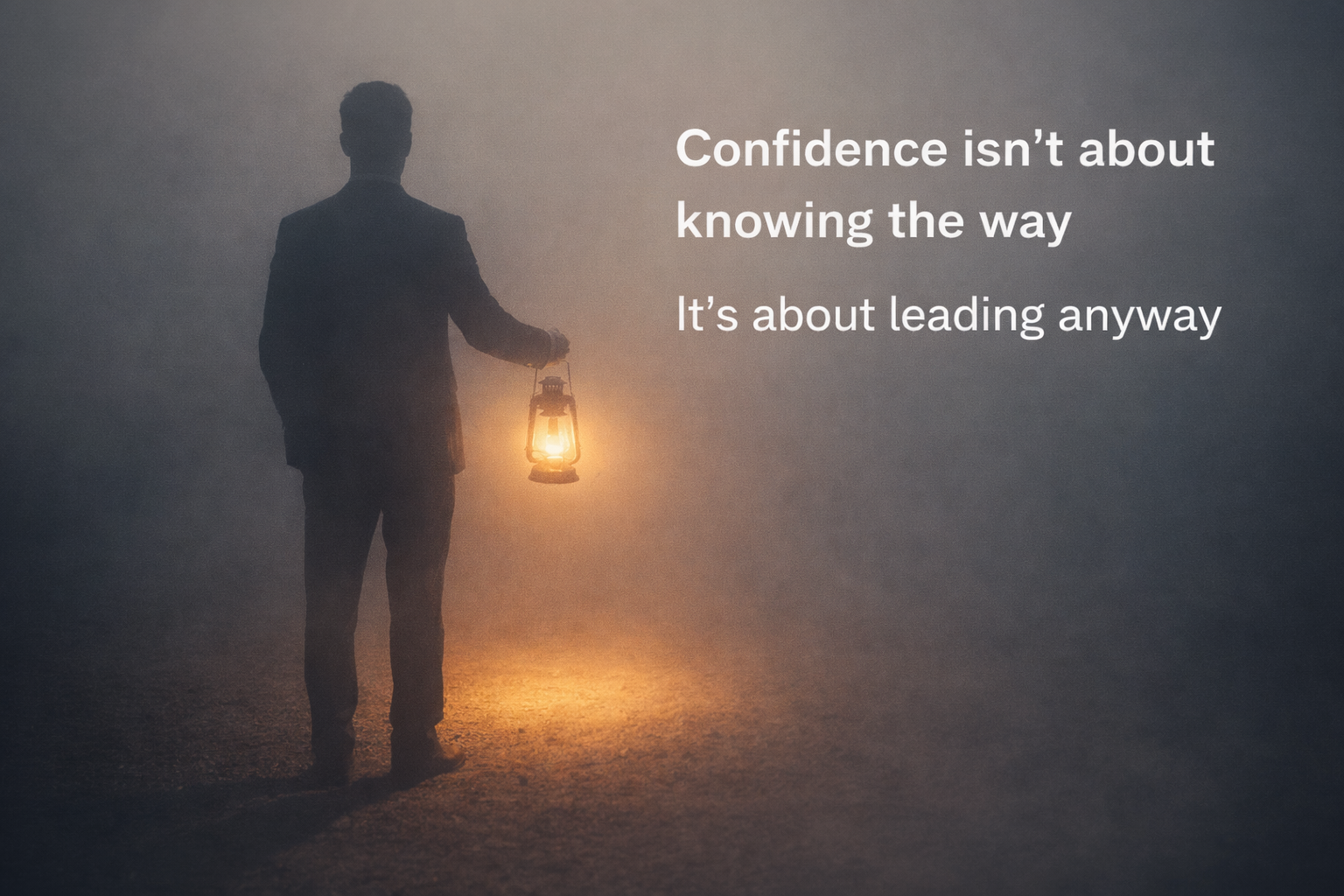
Transformational assignments are rarely neat. They are more often fog than roadmap—shifting conditions, unclear end-states, multiple stakeholders, and moving constraints. For senior executives accustomed to providing clarity, this can be disorienting. The instinct is to manufacture certainty: to declare a fixed plan, to over-specify, to project more confidence than one feels.
But in high-stakes, ambiguous contexts, pretending certainty is not leadership. It is risk. Real leadership in transformation is learning how to navigate the fog—offering steadiness without illusion, direction without rigidity, and confidence that does not depend on knowing every answer in advance.
Why Ambiguity is Inescapable in Transformation
Transformations, by definition, cross boundaries of the familiar involving new technologies, new processes, new coalitions, and often new mandates. Organizational change research emphasizes that transformational efforts are adaptive challenges (Heifetz, Grashow, & Linsky, 2009). They cannot be solved through technical expertise alone. Instead, they require discovery, experimentation, and adaptation in real time.
In the Canadian federal government, for instance, leaders pursuing service modernization cannot fully predict how regulatory frameworks, unions, or technology suppliers will align until the work is underway. In the private sector, leaders steering digital reinvention face similar unknowns—emerging customer behaviours, shifting competitor strategies, evolving technologies.
Ambiguity is not a flaw in these contexts; it is the terrain itself.
The Pitfalls of Pretending Certainty
When leaders feel pressured to provide answers they don’t have, they may:
- Over-specify early: locking into rigid plans that unravel as soon as conditions shift.
- Project false confidence: undermining credibility when reality contradicts the façade.
- Suppress dissent: discouraging teams from surfacing the very insights that could reduce uncertainty.
Edgar Schein (2013) cautions against leaders defaulting to “telling” when inquiry is required. Likewise, Amy Edmondson (2019) notes that psychological safety is eroded when leaders act as though ambiguity doesn’t exist, leaving teams reluctant to raise risks or propose alternatives.
The result: organizations stumble into predictable surprises, blindsided by the very dynamics their people saw but felt unable to voice.
Confidence as Presence, Not Prediction
So how does a leader sustain confidence in the fog? By shifting from equating confidence with “having the answers” to understanding it as presence in uncertainty.
- Model Adaptive Confidence
Adaptive confidence is not about being certain of outcomes, but about being certain of process. Leaders demonstrate confidence by showing they can convene the right people, hold competing perspectives, and steer iterative learning. - Communicate with Candour
Harvard’s Michael Roberto (2011) stresses that candour builds credibility. Leaders who admit what is unknown, while clearly stating what is known and how decisions will be made, gain trust rather than lose it. - Anchor in Purpose
While specifics may be uncertain, purpose and direction can remain clear. John Kotter (2012) emphasizes the power of a compelling “why” in change initiatives. Even in fog, leaders can anchor their teams to values and mission. - Create Safe-to-Fail Experiments
Dave Snowden’s Cynefin framework (2007) highlights the value of probing in complex contexts. Small, reversible experiments build learning without catastrophic risk. This practice embodies confidence—not that the leader knows the answer, but that the team will discover it together.
Practical Behaviours for Executives
- Name the fog: Acknowledge openly that ambiguity exists. This normalizes discomfort and creates shared resilience.
- Frame uncertainty as opportunity: Position the unknown as space for innovation, not just risk.
- Demonstrate calm in turbulence: Leaders who maintain composure help teams regulate their own anxiety.
- Protect learning time: Resist the temptation to drive only short-term deliverables; invest in sensemaking.
Leaders who combine candour with steadiness embody what Herminia Ibarra and Anne Scoular (2019) describe as “coaching leadership”—guiding with questions and frameworks rather than edicts.
The Executive Coaching Edge
Ambiguity is demanding. It erodes confidence and tempts even strong leaders into overcontrol. Executive coaching provides a structured, confidential space to resist those temptations.
A coach helps leaders:
- Distinguish between uncertainty that can be resolved and complexity that must be navigated.
- Test communication approaches to balance candour with confidence.
- Rehearse adaptive strategies before deploying them in politically or organizationally sensitive settings.
In this sense, coaching is not about adding technical answers but about fortifying presence. Leaders learn to embody confidence not because they know everything, but because they are equipped to steer wisely when no one does.
Thriving in the Fog
Executives are promoted or mandated into transformational roles precisely because the work is uncertain and consequential. Fog is the job. Those who can project confidence without pretending certainty create conditions for their organizations to adapt, discover, and succeed.
For leaders willing to embrace ambiguity as the arena of growth, transformation becomes not just a professional challenge but an opportunity to redefine what confident leadership truly means.
The Institute X Coaching Option
If your mandate feels more fog than map, you are not failing—you are leading where certainty cannot go. Partnering with the right support can help you embody the kind of confidence that thrives in ambiguity, sustaining momentum and trust even when the path is unclear.
Institute X is a transformation leadership consultancy and transformation/change leader coaching firm. One of its online presences is The Change Playbook. Be sure to check out the abundance of practical and pragmatic guidance. Subscribe to be notified of new, fresh content.
References
Edmondson, A. C. (2019). The fearless organization: Creating psychological safety in the workplace for learning, innovation, and growth. Wiley.
Heifetz, R., Grashow, A., & Linsky, M. (2009). The practice of adaptive leadership: Tools and tactics for changing your organization and the world. Harvard Business Press.
Ibarra, H., & Scoular, A. (2019). The leader as coach. Harvard Business Review.
Kotter, J. (2012). Leading change. (Rev. ed.) Harvard Business Review Press.
Roberto, M. A. (2011). Why great leaders don’t take yes for an answer: Managing for conflict and consensus. FT Press.
Schein, E. H. (2013). Humble inquiry: The gentle art of asking instead of telling. Berrett-Koehler.
Snowden, D. (2007). A leader’s framework for decision making. Harvard Business Review.