
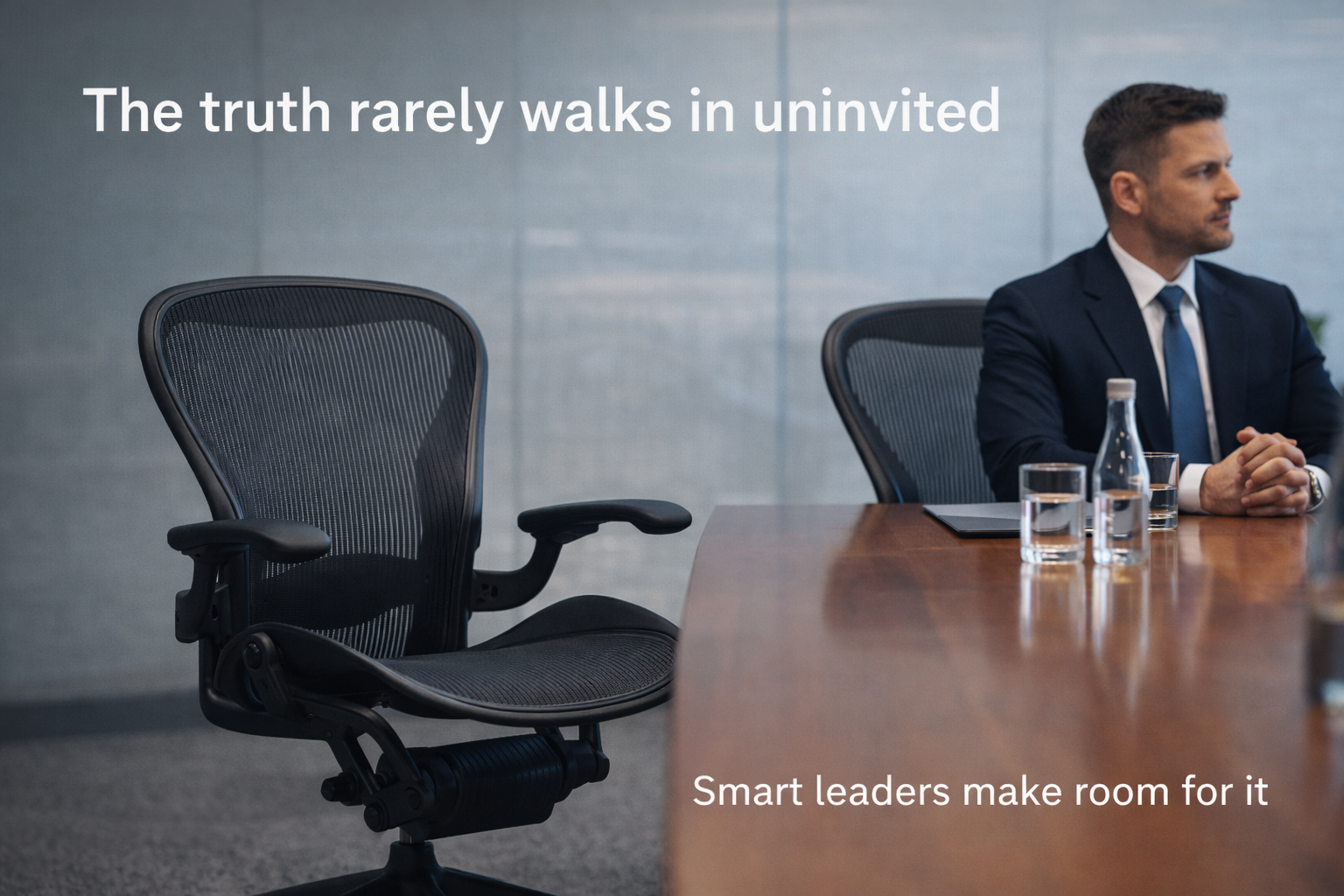
Why Leaders Need Honest Feedback in Transformation
In transformational assignments, leaders are often lauded for their decisiveness and confidence. Yet the same qualities that secure promotion or high-stakes mandates can become liabilities when they mute honest feedback. The paradox of senior leadership is that the higher you rise, the less candid input you receive—and the more you need it.
Transformational contexts compound this problem. When conditions are ambiguous and solutions uncertain, a leader’s judgment must constantly adapt. Without timely, unvarnished feedback and trusted challenge, blind spots widen, decisions ossify, and credibility erodes. The very executives tasked with guiding systemic change risk being the least informed about the reality on the ground.
Why Feedback is Scarce at the Top
Several well-documented dynamics make it harder for senior leaders to access honest perspectives:
- Deference to authority: Subordinates hesitate to contradict the person who controls their evaluations and career prospects.
- Organizational filtering: By the time information reaches senior executives, it is often “smoothed” to avoid conflict or present good news.
- Political dynamics: In high-stakes transformations, some stakeholders benefit from shielding leaders from uncomfortable truths.
- Self-protection: Executives themselves may unconsciously signal they are not open to challenge, even if they believe they are.
Ron Heifetz (1994) famously observed that leadership involves “disappointing people at a rate they can absorb.” When leaders avoid hard truths, they delay disappointments until they become crises.
The Cost of Echo Chambers
Lack of honest feedback in transformation produces predictable risks:
- Strategic myopia: Leaders over-rely on their own perspective, missing weak signals and emergent risks.
- False confidence: Teams assume silence equals agreement, reinforcing flawed assumptions.
- Culture of fear: Organizations learn that candour is unsafe, undermining psychological safety and innovation (Edmondson, 2019).
- Loss of credibility: When reality eventually surfaces—whether through media, auditors, or stakeholder pushback—leaders appear out of touch or disingenuous.
As Sydney Finkelstein (2003) documents in Why Smart Executives Fail, many corporate collapses were not caused by lack of intelligence, but by insulated leaders unable or unwilling to hear dissent.
What Trusted Challenge Looks Like
Trusted challenge is not about contrarians or constant negativity. It is the disciplined practice of surfacing reality, testing assumptions, and strengthening judgment.
Effective challenge has three characteristics:
- Credible: Comes from individuals who understand the context deeply enough to provide meaningful critique.
- Constructive: Aims to improve decisions and outcomes, not to score points or undermine authority.
- Confidential (when needed): Allows leaders to test thinking without reputational cost.
Edgar Schein’s (2013) Humble Inquiry highlights the value of inquiry-driven dialogue: asking genuine questions that elicit truths otherwise hidden. Similarly, McKinsey research emphasizes that diverse perspectives in decision-making significantly improve outcomes, but only when leaders create conditions where dissenting voices are genuinely heard (Benson-Armer et al., 2015).
Creating Conditions for Honest Feedback
Senior leaders can intentionally cultivate feedback-rich environments by:
- Inviting dissent explicitly: Signal that contrary views are expected, not punished.
- Rewarding candour: Publicly acknowledge those who raise tough issues constructively.
- Decoupling status from truth: Ensure that the merit of an idea does not depend on its source.
- Modelling vulnerability: Admit mistakes and uncertainties to normalize candour.
Amy Edmondson’s (2019) work on psychological safety is unequivocal: without these signals from leadership, employees will default to silence, even when they see risks unfolding.
The Role of Executive Coaching
While cultural practices help, senior leaders also need private, structured spaces to test assumptions and receive unfiltered challenge. This is where executive coaching plays a unique role.
A skilled coach provides:
- A mirror: Reflecting patterns the leader may not see in themselves.
- A challenger: Asking the difficult questions others avoid.
- A sounding board: Providing space to trial strategies before they go public.
- A safeguard: Protecting against the isolation and blind spots of seniority.
As Marshall Goldsmith (2007) notes in What Got You Here Won’t Get You There, successful leaders often fail because they cling to habits that worked in past contexts but now hinder adaptation. Coaches accelerate unlearning and relearning by challenging those ingrained behaviours.
Honest Feedback as a Strategic Asset
Far from being a sign of weakness, leaders who cultivate trusted challenge demonstrate the self-confidence to prioritize reality over ego. In transformational settings, this is not optional—it is a strategic asset.
Executives who embrace feedback create organizations that adapt faster, innovate more, and sustain credibility. Those who avoid it risk drifting into illusions until reality forces a painful reckoning.
The choice is stark: build a culture and practice of honest challenge, or be blindsided by truths withheld.
The Institute X Coaching Option
If you are leading transformation, insulation is your enemy. Now is the time to cultivate the kind of honest challenge and trusted feedback that keeps you grounded in reality and sharp in judgment. Executive coaching can provide that critical edge—confidential, unvarnished, and designed to help strong leaders grow stronger.
Institute X is a transformation leadership consultancy and transformation/change leader coaching firm. One of its online presences is The Change Playbook. Be sure to check out the abundance of practical and pragmatic guidance. Subscribe to be notified of new, fresh content.
References
Benson-Armer, R., Noble, S., & Thiel, A. (2015). How leaders kill meaning at work. McKinsey Quarterly.
Edmondson, A. C. (2019). The fearless organization: Creating psychological safety in the workplace for learning, innovation, and growth. Wiley.
Finkelstein, S. (2003). Why smart executives fail: And what you can learn from their mistakes. Penguin.
Goldsmith, M. (2007). What got you here won’t get you there: How successful people become even more successful. Hyperion.
Heifetz, R. A. (1994). Leadership without easy answers. Harvard University Press.
Schein, E. H. (2013). Humble inquiry: The gentle art of asking instead of telling. Berrett-Koehler.