
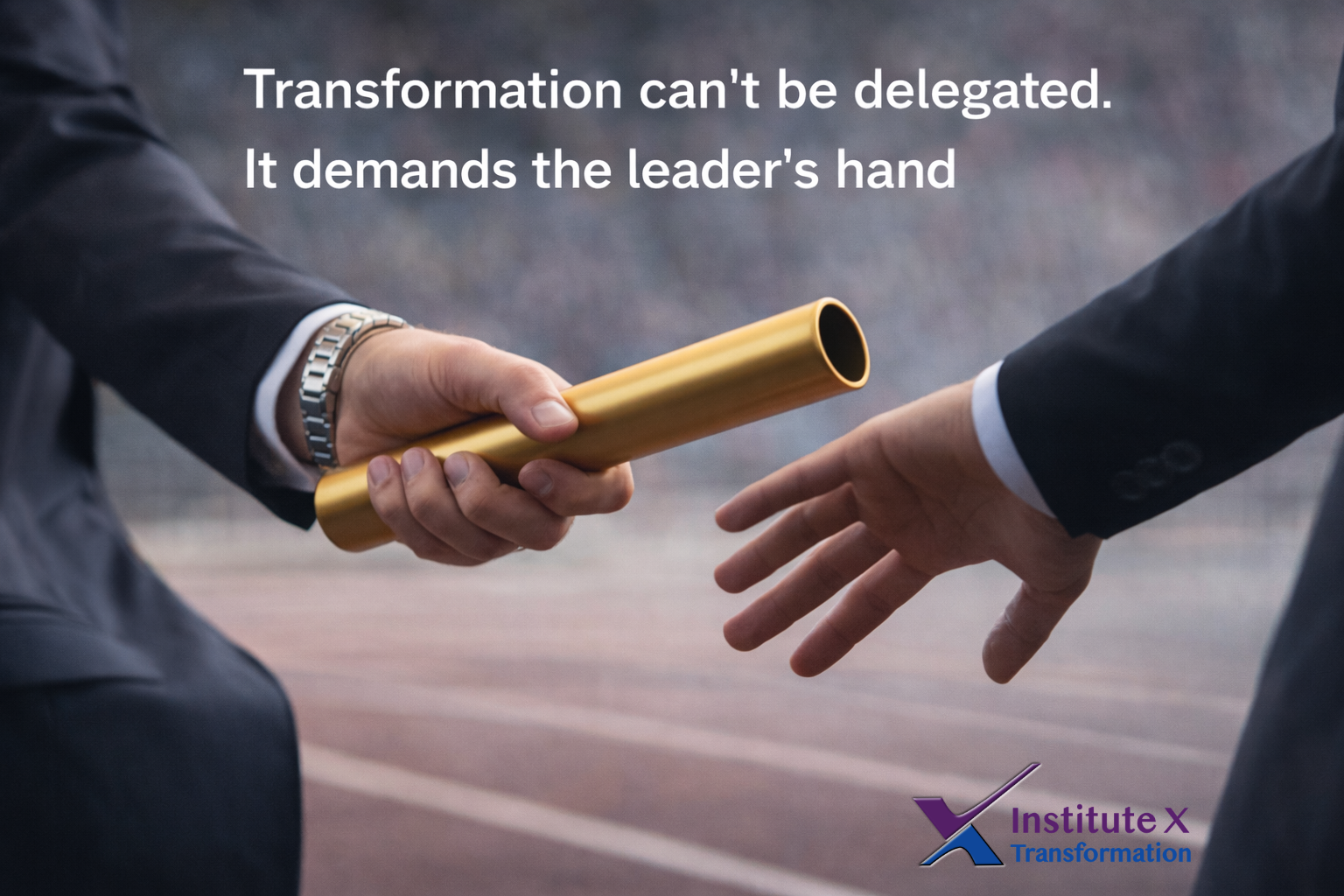
Why Transformation Can’t Be Delegated Downward
One of the most common mistakes in major transformation efforts is the belief that the leader can set direction and then hand off execution to others. Delegation works in routine operations. But in transformation—where ambiguity is high, stakes are large, and resistance is inevitable—the leader’s direct presence and engagement are essential. Transformation is not a project to be managed from a distance; it is a mandate that requires personal ownership at the very top.
Executives often underestimate this. They assume their role is to articulate a vision, appoint a strong team, and hold them accountable. But transformation is not a simple cascade. It requires continuous leader involvement to navigate politics, signal priorities, and sustain energy across the organization. Without it, even the best strategies stall.
Why Delegation Works in Operations but Fails in Transformation
In operations, delegation is essential. Leaders set clear objectives, delegate responsibilities, and trust teams to deliver within established processes. This works because the environment is relatively stable, cause-and-effect relationships are predictable, and performance measures are well-defined.
Transformation is different. As Kotter (1995) argued in his landmark Leading Change, transformation involves unfreezing entrenched behaviors and reshaping systems, which demands visible and consistent leadership commitment. Unlike incremental improvements, transformation destabilizes the organization. Leaders cannot outsource the authority, credibility, or symbolic weight needed to keep people engaged through the discomfort of change.
The Symbolic Role of Leadership in Transformation
Leaders are more than decision-makers; they are symbols. Employees look to them for cues about what matters and what is safe to pursue. If the leader is not visibly engaged in the transformation, employees conclude it is optional—or worse, a passing fad.
John Gardner (1990) emphasized in On Leadership that leaders must embody the change they seek. When leaders remain distant, transformation becomes rhetoric rather than reality. Conversely, when leaders participate—by showing up in transformation meetings, addressing resistance directly, and modeling new behaviors—they make the change credible.
Why Transformation Cannot Be Pushed Downward
Several dynamics make top-leader involvement non-negotiable:
- Complexity and ambiguity: Lower levels of the organization often lack the perspective to balance competing priorities or resolve cross-functional tensions. Only the leader can integrate these.
- Authority and credibility: Resistance to change often comes from powerful stakeholders. Without top-level engagement, resistance festers.
- Resource allocation: Transformation requires breaking through inertia in budgeting, staffing, and systems. Only leaders can make those calls decisively.
- Energy and attention: Transformation is exhausting. Leaders sustain energy by showing commitment, even when fatigue sets in.
A 2015 McKinsey Global Survey found that transformations where leaders were visibly involved were 5.3 times more likely to succeed than those where leaders delegated responsibility downward.
What Leader Involvement Looks Like
Owning transformation does not mean micromanaging. It means leaders must show up in the following ways:
- Communicating relentlessly. Articulating the purpose of transformation in every setting, not just at the launch.
- Modeling behaviors. Demonstrating through personal choices that the transformation is real (e.g., reallocating budget, changing personal routines).
- Navigating politics. Engaging directly with resisters and influencers to resolve conflicts that no one else can.
- Creating psychological safety. Signaling that experimentation is encouraged, even if it leads to failure.
- Sustaining momentum. Celebrating wins, calling out progress, and reminding the organization why the transformation matters.
This is not work that can be subcontracted to middle managers or consultants. It must come from the top.
The Cost of Leader Absence
When leaders distance themselves from transformation:
- Employees disengage. They sense the effort is low priority.
- Resistance flourishes. Without top-level pressure, entrenched interests prevail.
- Energy dissipates. Change fatigue sets in, and momentum fades.
- Credibility erodes. Leaders lose trust if they appear to be advocating transformation without personally investing in it.
Research by Beer, Eisenstat, and Spector (1990) demonstrated that “change programs” often fail not because of poor ideas, but because senior leaders fail to model and reinforce the change.
Reframing the Leader’s Role
Transformation is not just another initiative—it is the leader’s mandate. Executives must reframe their role: from delegators of change to stewards of transformation. This reframing is critical not only for organizational success but also for personal credibility.
As Ronald Heifetz (1994) described in Leadership Without Easy Answers, adaptive challenges cannot be solved by technical fixes. They require leaders to mobilize people to face reality, take risks, and learn new ways. That work cannot be done from the sidelines.
The Role of Coaching in Sustaining Leader Engagement
Executive coaching plays a pivotal role here. Leaders under pressure to delegate may need a confidential space to:
- Explore their ambivalence about staying deeply engaged.
- Build resilience for the personal demands of sustained involvement.
- Practice strategies for visible and symbolic leadership.
- Maintain perspective when resistance or fatigue set in.
By keeping the leader centered and committed, coaching ensures that the transformation does not lose its anchor at the top.
The Institute X Coaching Option
Transformation is too important to be delegated. Leaders must stand at the center, embodying the change they demand. If you are carrying a transformational mandate, coaching can help you stay resilient, credible, and deeply engaged—because your presence is not optional; it is decisive.
Institute X is a transformation leadership consultancy and transformation/change leader coaching firm. One of its online presences is The Change Playbook. Be sure to check out the abundance of practical and pragmatic guidance. Subscribe to be notified of new, fresh content.
References
Beer, M., Eisenstat, R. A., & Spector, B. (1990). “Why change programs don’t produce change.” Harvard Business Review.
Gardner, J. W. (1990). On leadership. Free Press.
Heifetz, R. A. (1994). Leadership without easy answers. Harvard University Press.
Kotter, J. P. (1995). “Leading change: Why transformation efforts fail.” Harvard Business Review.
McKinsey & Company. (2015). “Why your transformation will fail.”