
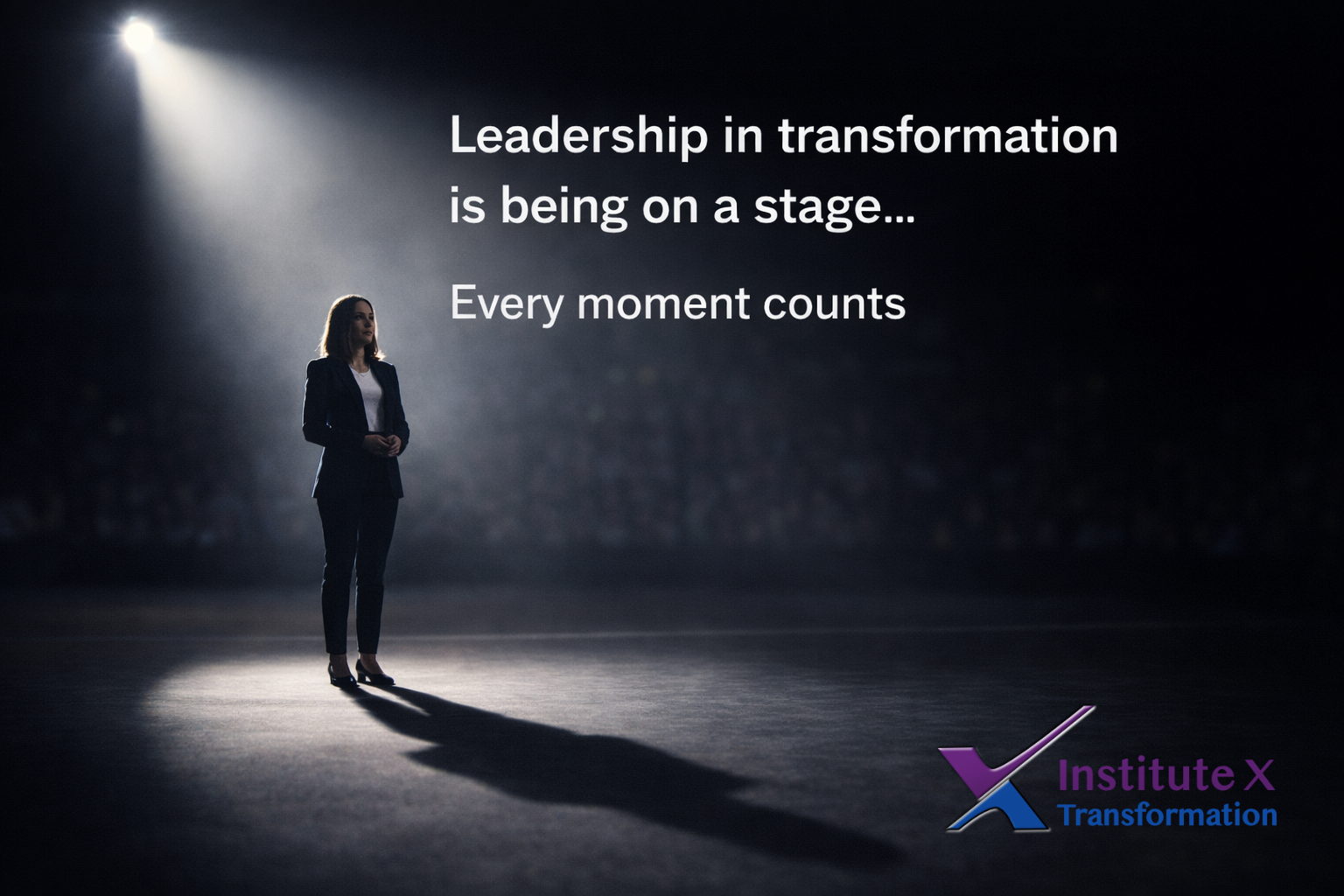
Leading Under Scrutiny and Stress
Transformation doesn’t just challenge systems and structures—it tests the resilience of the leader at the center. Senior executives charged with driving large-scale change face not only ambiguous problems and high stakes but also relentless scrutiny. Every action, decision, and even hesitation is magnified. The personal demands are immense, and the emotional toll is often underestimated.
For leaders in these roles, the challenge is not just technical. It is psychological, emotional, and deeply human. Navigating transformation requires managing stress, maintaining confidence under fire, and finding ways to stay centered while the organization swirls with uncertainty.
The Scrutiny Trap: Why Leaders Feel Exposed
When organizations are in flux, people look to their leaders with heightened attention. Research by Goffee and Jones (2006) in Why Should Anyone Be Led by You? shows that employees want authenticity in leaders—but during transformation, that expectation is coupled with hyper-sensitivity. Small gestures are over-interpreted, silence can be taken as disapproval, and inconsistencies are amplified.
This constant observation leaves leaders feeling perpetually “on stage.” Harvard’s Ronald Heifetz called this “holding steady” in Leadership Without Easy Answers (1994): leaders must withstand pressure without reacting impulsively or withdrawing. The scrutiny trap can be exhausting, eroding confidence and draining energy if leaders lack strategies to manage it.
The Stress of Ambiguity
Transformation magnifies stress because it unfolds in ambiguity. Unlike operational challenges, where solutions are clear and outcomes measurable, transformational mandates involve trial, error, and iteration. Leaders must make consequential decisions with incomplete data while knowing their judgments will be second-guessed.
Neuroscience research reinforces why this is difficult. Rock (2008) in the NeuroLeadership Journal describes how ambiguity triggers the brain’s threat response, heightening stress and reducing cognitive flexibility. For leaders, this means that ambiguity not only increases pressure but also impairs the very capacities—judgment, creativity, empathy—needed to succeed.
Emotional Toll: The Risk of Burnout and Isolation
The combination of scrutiny and ambiguity creates a perfect storm for executive burnout. Studies published in the Harvard Business Review (Keller & Meaney, 2017) found that transformation efforts often fail in part because leaders underestimate the personal stamina required. The emotional burden—feeling alone at the top, carrying others’ anxieties, and having no safe space to express doubt—can lead to isolation.
Isolation is dangerous. Without outlets for honest reflection and support, leaders can slip into defensive routines: avoiding hard conversations, reverting to command-and-control, or doubling down on failing strategies. The very behaviors that undermine transformation are often symptoms of unacknowledged emotional strain.
Why Ignoring the Toll Backfires
Leaders sometimes try to tough it out, assuming resilience means suppressing stress. But ignoring the emotional toll backfires. Studies on executive burnout (Maslach & Leiter, 2016) show that unaddressed stress leads to decreased effectiveness, health risks, and higher turnover. In transformation contexts, this has cascading effects: if the leader falters, the change loses its anchor.
Moreover, when leaders fail to acknowledge their own stress, they inadvertently set a culture of denial. Employees see that vulnerability is unsafe, discouraging the openness and experimentation transformation requires.
Strategies for Managing the Toll
Leaders cannot eliminate the emotional toll of transformation—but they can manage it. Effective strategies include:
- Creating space for reflection. Time away from the “stage” is essential for clarity. Bill George (2007) in True North emphasizes reflection as a key to authentic leadership.
- Building trusted relationships. A confidential circle—whether coaches, mentors, or peers—provides relief from isolation and perspective on challenges.
- Normalizing vulnerability. Sharing appropriate doubts signals authenticity without undermining authority. This strengthens trust.
- Practicing stress regulation. Techniques such as mindfulness, exercise, and structured downtime improve resilience and cognitive flexibility (Kabat-Zinn, 2005).
- Reframing stress. Viewing challenges as growth opportunities rather than threats enhances performance, as shown by Crum, Salovey, & Achor (2013) in the Journal of Experimental Social Psychology.
These practices don’t erase the toll—but they transform it into a manageable and even developmental force.
Coaching as a Buffer and Catalyst
Executive coaching is uniquely valuable in this context. Unlike advisors or subordinates, coaches provide a confidential space where leaders can:
- Acknowledge emotional strain without reputational risk.
- Reframe stress to recover confidence and focus.
- Test strategies for communication and presence under scrutiny.
- Build habits that sustain resilience over the long haul.
Research supports this. A 2013 Journal of Positive Psychology study by Theeboom, Beersma, and van Vianen found that coaching significantly reduces stress while improving goal attainment and resilience. For leaders in transformation, this makes coaching not a luxury, but a necessity.
Conclusion
Transformation exacts a psychological price. Leaders who ignore it risk burnout, poor judgment, and undermined credibility. Those who acknowledge and manage the emotional toll, however, not only preserve their effectiveness but also model resilience for the entire organization.
The role of a leader in transformation is not only to drive change in others but to sustain change within themselves. That is the real crucible of leadership under scrutiny and stress.
The Institute X Coaching Option
If you are leading transformation and feel the strain of scrutiny and stress, know this: the toll is real, but it does not have to erode your effectiveness. With the right support and practices, you can not only endure but also thrive—and model the resilience your organization needs. Coaching provides that confidential ally to help you stay strong in the crucible of transformation.
Institute X is a transformation leadership consultancy and transformation/change leader coaching firm. One of its online presences is The Change Playbook. Be sure to check out the abundance of practical and pragmatic guidance. Subscribe to be notified of new, fresh content.
References
Crum, A. J., Salovey, P., & Achor, S. (2013). Rethinking stress: The role of mindsets in determining the stress response. Journal of Experimental Social Psychology, 49(4), 719–728.
Gardner, J. W. (2006). Why should anyone be led by you? Harvard Business School Press.
George, B. (2007). True north: Discover your authentic leadership. Jossey-Bass.
Heifetz, R. A. (1994). Leadership without easy answers. Harvard University Press.
Kabat-Zinn, J. (2005). Coming to our senses: Healing ourselves and the world through mindfulness. Hyperion.
Keller, S., & Meaney, M. (2017). “At the heart of transformation: How senior executives drive change.” Harvard Business Review.
Maslach, C., & Leiter, M. P. (2016). Burnout: The cost of caring. Malor Books.
Rock, D. (2008). “SCARF: A brain-based model for collaborating with and influencing others.” NeuroLeadership Journal, 1(1), 44–52.
Theeboom, T., Beersma, B., & van Vianen, A. E. (2013). Does coaching work? A meta-analysis on the effects of coaching. The Journal of Positive Psychology, 9(1), 1–18.