
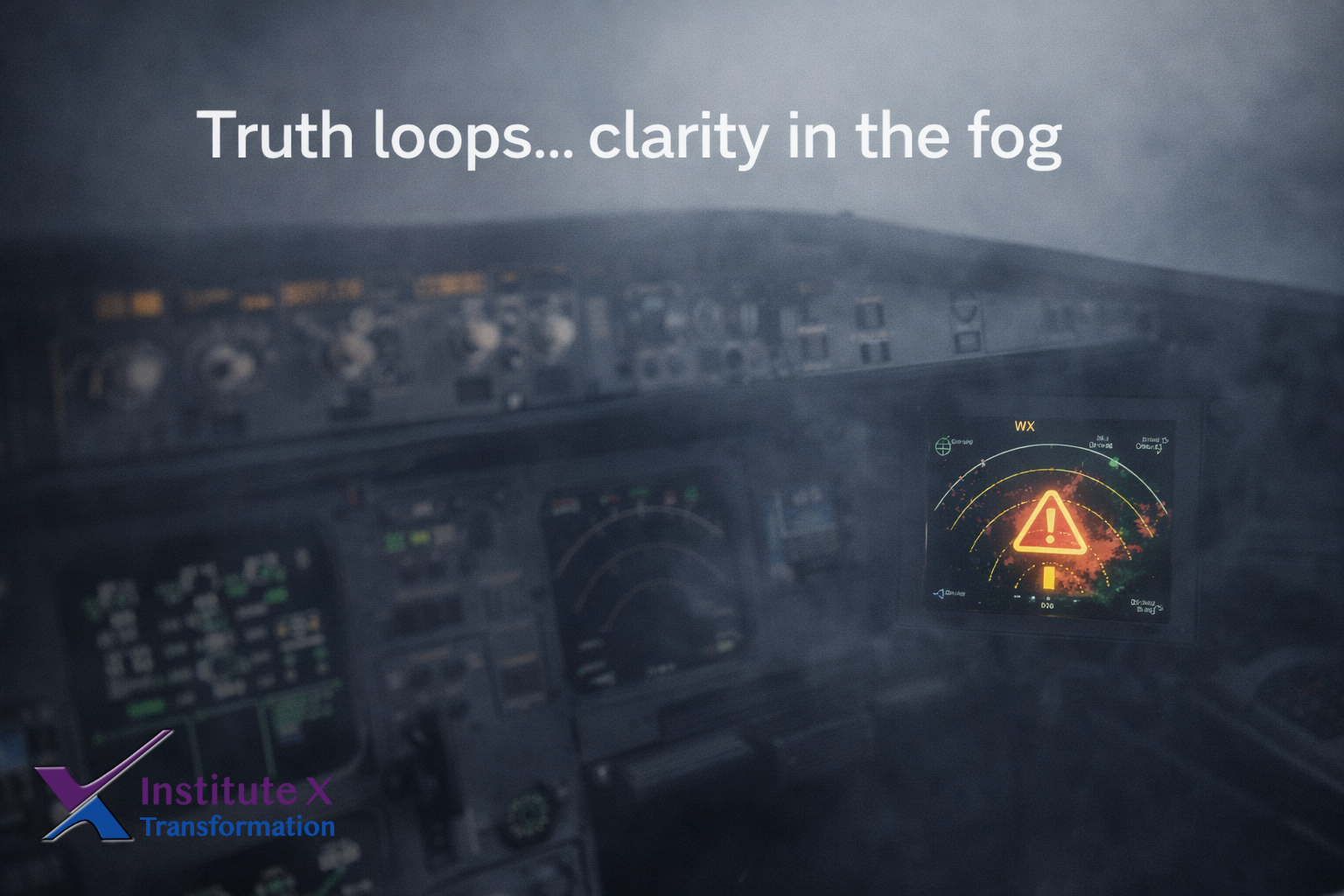
Building “Truth Loops” Outside the System
Every transformational leader craves clarity. Yet inside large organizations—particularly government—clarity is often in short supply. Politics, risk aversion, and filtered communication mean that what leaders hear is more performance than truth. (See Weeks 18–19.)
That leaves leaders with a choice: either accept the distortions of the system, or deliberately cultivate what I call truth loops—channels of feedback and reflection that operate outside the constraints of hierarchy and organizational politics.
Why Truth Loops Matter in Transformation
Transformational mandates are uniquely vulnerable to distorted information. The work is novel, ambiguous, and high-stakes. Leaders are navigating untested terrain, where old playbooks provide little guidance. In these contexts, distorted information isn’t just frustrating—it’s dangerous.
Chris Argyris (1991) argued that organizational “defensive routines” insulate leaders from uncomfortable truths, reinforcing blind spots and blocking learning. Similarly, Edgar Schein’s work on organizational culture showed how embedded norms discourage dissent, making real candor rare.
Without deliberate countermeasures, leaders risk navigating complexity with false maps.
Externality as the Key
What makes truth loops effective is not just the act of feedback—it is the externality of it. When voices are free from the incentives and politics of the system, candor becomes possible.
Karl Weick’s research on sensemaking (1995) underscores this point: in ambiguous contexts, leaders rely on narratives constructed by those around them. If those narratives are filtered, leaders make flawed interpretations.
By deliberately seeking external loops, leaders widen the aperture, correcting distortions with perspectives that are not beholden to internal self-interest.
What Truth Loops Look Like
Truth loops are not one-size-fits-all. They may take the form of:
- A seasoned mentor outside the organization who has navigated similar stakes.
- An advisory board assembled not for governance but for candor.
- Peer circles or external networks where leaders can test ideas without political risk.
- Executive coaches who serve as confidential challengers, not evaluators.
What unites these is their independence from the leader’s internal ecosystem.
Why Leaders Fail to Build Them
Ironically, the very leaders who most need truth loops often avoid them. There are three common reasons:
- Confidence bias. Leaders overestimate their ability to interpret internal signals correctly (Kahneman & Tversky, 1979).
- Busyness. In transformational settings, time is consumed by delivery. Building external loops feels like a luxury.
- Cultural suspicion. In government especially, seeking external advisors may be viewed as disloyal or risky.
But these rationalizations are shortsighted. Without external correction, leaders may march confidently in the wrong direction—at great cost.
Case Example: A False Map Corrected
A deputy minister in a federal agency once relied on her executive team for signals about a major transformation. The team dutifully shared risks and concerns—but only those deemed “safe.” When the initiative stalled, she brought in a retired peer as an informal advisor. Within weeks, he surfaced unspoken tensions that no one inside had dared to articulate.
This was the turning point: with external candor, the leader reoriented the program before failure became irreversible.
Building Truth Loops as Leadership Discipline
Leaders cannot wait for truth to emerge organically. They must design for it. Just as one builds governance structures or accountability mechanisms, so too must they build structures for candor.
This requires:
- Intentionality: Recognizing that truth will not flow naturally inside the system.
- Regularity: Making external challenge a recurring discipline, not an occasional check-in.
- Openness: Approaching external candor not as judgment but as a resource.
Truth loops are not a sign of weakness—they are a mark of maturity.
Conclusion
Transformation magnifies distortion. Leaders who mistake managed dissent for candor are flying with faulty instruments. But those who deliberately cultivate external truth loops gain what few others have: unvarnished clarity in the fog of complexity.
The Institute X Coaching Option
At Institute X, we specialize in serving as that kind of trusted external partner. Our coaching is designed not to flatter, nor to direct, but to challenge and clarify—so leaders can lead transformational change with confidence rooted in reality, not illusion.
If you are navigating transformation, don’t settle for the false comfort of internal candor. Build the truth loops that will keep you on course. Let us help.
Institute X is a transformation leadership consultancy and transformation/change leader coaching firm. One of its online presences is The Change Playbook. Be sure to check out the abundance of practical and pragmatic guidance. Subscribe to be notified of new, fresh content.
References
Argyris, C. (1991). Teaching smart people how to learn. Harvard Business Review.
Kahneman, D., & Tversky, A. (1979). Prospect theory: An analysis of decision under risk. Econometrica, 47(2), 263–291.
Schein, E. H. (1985). Organizational culture and leadership: A dynamic view. Academy of Management Review, 10(4), 601–609.
Weick, K. E. (1995). Sensemaking in organizations. Sage.