
Digital Transformation Canada and SSC
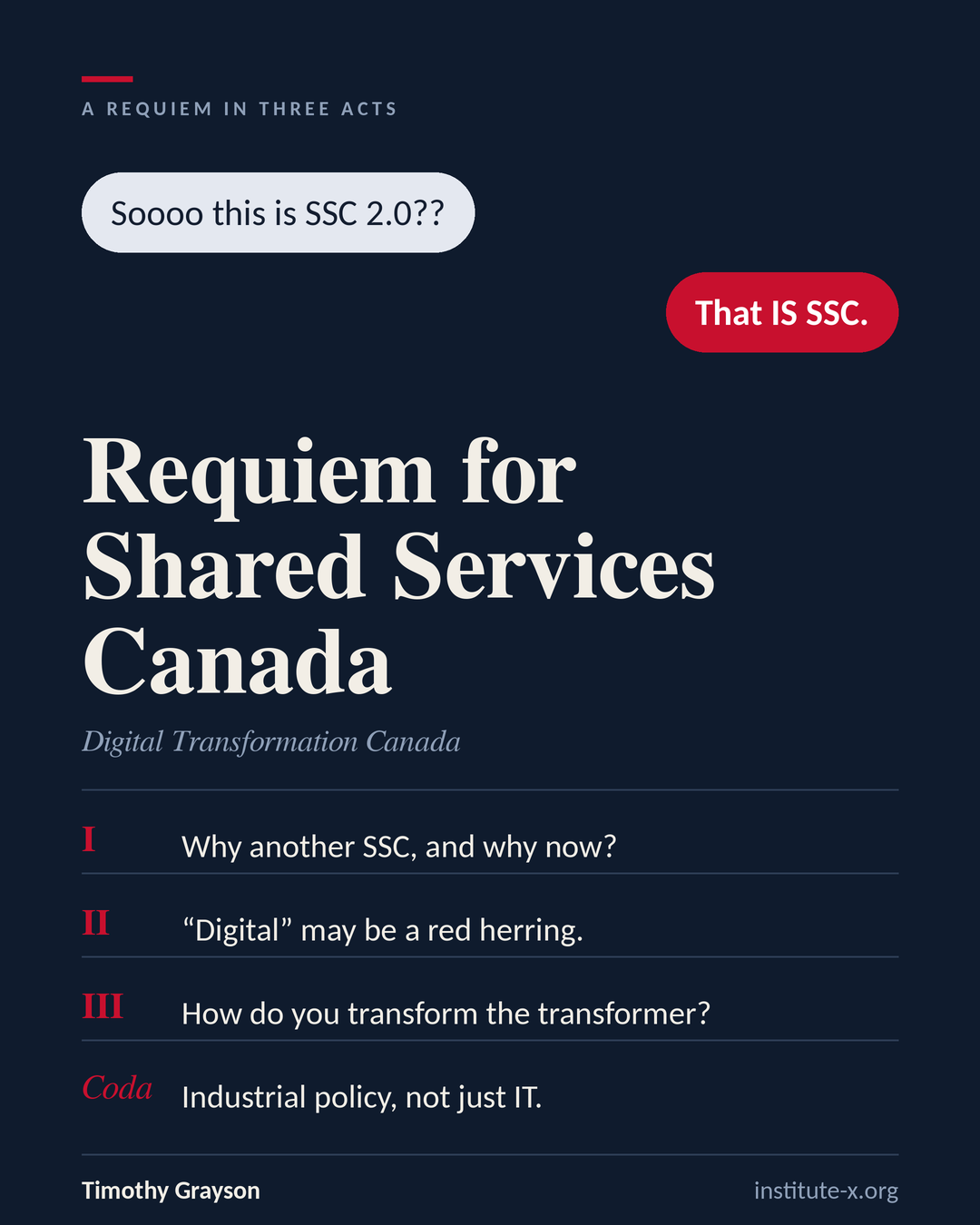
Digital Transformation Canada (DTC) is a requiem for Shared Services Canada (SSC) in three acts.[1]
More commonly sensible people than me opine on the viability of this move. Maybe they are right. Most of predicting the future is half luck, as the inestimable Yogi said. My luck is not that great. Besides, merely not regressing to the status quo—again—will probably be success.
Act I: The SSC Doppelganger Arrives
I got a text that read, “Scott Jones is moving to be the Chief of CSE.” Scott Jones had been the CEO at SSC and was apparently moving on to Canadian Security Establishment. Barely had I thought Geez, who hates them? when a follow up pinged: “Today, the Prime Minister announced an important step forward in the Government of Canada’s digital transformation: the creation of Digital Transformation Canada and the appointment of Patrick Pichette as its new Chief Executive Officer.”
The suspiciously timely message contained only parts of the PMO’s press release. (Full text here.)
Side note: to search Patrick Pichette is to be overwhelmed by a curriculum vitae. McKinsey, Bell, Google (effectively running the juggernaut with responsibility for HR and bizops while nominally CFO). Venture capital. Rhodes Scholar.
What caught my eye:
“Scale shared solutions across government to reduce duplication and operating costs, making better use of emerging technologies…, strengthening Canada’s digital sovereignty and security, and improving Canadians’ experience with federal services,” it said, specifying, “… reduce administrative burden, improve efficiency, and help departments focus on delivering their core programs and services.”
“Use the Government of Canada’s purchasing power more strategically to help Canadian digital and AI companies test, scale, and commercialise new technologies — creating opportunities for Canadian firms to grow at home and compete globally.”
My correspondent asked, “Soooo this is SSC 2.0??”
Having been inside and around SSC, my instant answer was: That IS SSC.
If my assessment was right, based as it is on a decade of government public utterances, so many questions go begging. Like: “Why? Why another SSC?” And naturally, “What about the current SSC?”
Why?
Every previous political master had similar goals. The usual solution of replacing leadership and replenishing rank-and-file had little impact though. SSC, the organization, stubbornly resisted real improvement (“transformation”?), holding faith in the righteousness of defiant mediocrity.
Now a grudge is being visited upon it. One fuelled by irrationality, such as:
- If SSC were delivering on efficiency and effectiveness expectations, why the persistent leadership replacement, reorganization, and purge?
- If SSC were high calibre in its field, would every department that could, avoid dealing with it and those that could not build their own IT organizations?
- If the SSC executive cadre was high calibre, wouldn’t some effective leadership and real success have happened—even by accident?
- If SSC were not immune to common remedy, would anyone even consider more than “reinvigorating” the executive cadre, leaving structure to the executives?
- And, ultimately: If SSC were successful during its near 15-year operation, why replace it?
On September 4, 2026, the Prime Minister voted non-confidence on SSC and that more of the same remedy would fix SSC. No doubt the PMO then looked farther afield to find other impediments to success that beguiled SSC all those years.
For instance, they found the incomprehensible separation of policy and practice (i.e., policy at Treasury Board Secretariat—TBS and practice at SSC) that left SSC with no practical authority to master its fate. It could struggle against but was ultimately required to follow TBS’s direction—that came from technical “experts” at TBS.[2] An observer could see it as the real problem and culprit.
Surely the PMO knows that culture and structure renders the federal government a Confederacy of Departments.[3] So even if/when TBS and SSC got their act together, other departments were not usually obliged to acquiesce except by their own judgment. How does a shared service succeed unless everyone shares?
And SSC’s own ever-evolving structure that tacked with the latest “framework” wind gust was and remained faithfully reflective of public service culture. One that rewards process and rule-following more than practical success; that talks a lot about money and efficiency but does little to secure actual value; one more conscious of good relations than good business.
All told, structure and culture were ill-suited to achieving SSC’s 15-year old objective. With culture hard to bend and structure influencing if not determining outcome, SSC could only remain intractably stuck so long as it remained.
Why now?
Thus far: no new executive leader, no new IT paradigm, no added money nor resources solved SSC’s alleged problem. Carney—for his part, is not by training, temperament, or experience likely to try harder with proven failures. Logically, there was no other choice.
- IF shared (IT) services and government transformation have failed;
- IF that contributes to lacklustre government productivity (despite digitization);
- IF the illusive benefits of AI are within reach only for prepared organizations; and
- IF it’s all a long pole in the PM’s “Change Canada” tent,
THEN big change had to come.
SSC, like other departments, is both intractable and immovable: bound by organizational inertia, union immobilization, and toxic culture. Alexander had to cleave this Gordian knot. Besides, at least for political reasons incentives to kick the can farther down the road vapourized.
Act II: I come to bury SSC, not to praise it
Obviously, new DTC is not just old SSC and its original mandate. For one: only shared IT services fell under SSC purview. Thus SSC saw new and novel frameworks and stacks, mobility and WIFI, new devices, (eventually) cybersecurity, data structures, and so forth. There’s nothing wrong with any of that, but to the average department it’s disruptive not transformative.
For departments that are not SSC, even digital transformation cannot be about technology evolution. It is everything the technology changes: about the second and third-order impacts.
Consider how computer evolution since the late 1970s transformed in waves. Before the Wang word processor (a first-order technological transformation), law firms and business offices were overflowing with stenographers and secretaries. Every edited version of every document had to be retyped in total. The word processor transformed that first by reducing retyping to only that which was changed and instantly regenerating a new version. That was the second order transformation: goodbye steno pool; see you on Mad Men.
Most insidious is the resultant, third-order transformation. When it took much effort and time, editing was a thoughtful process done once—twice at worst. After word processing migrated to the PC, revisions happen so easily and quickly that every idle executive or other bystander can implement any esoteric syntax or punctuation change, repeatedly. The same goes for presentations and numbers. When they took time and effort to create, they were considered and fewer. Is that how things work today? No, it’s transformed to be less considered and pathologically iterative.
Whether it’s better or worse today than in the past is beside the point, which is that the real transformation was not the (information) technology; it was how labour and capital were reorganized and retasked because of it. SSC, focused on the tech, had neither expertise nor authority to deal with anything beyond the technology itself.
So “digital” in DTC may be a red herring. To transform government on the back of digital, DTC must go beyond what SSC could ever attempt. Policy owners with technology specialists, under singular leadership, adds practical implementation muscle to broad transformational policy. Probably insufficient, but a good start.
Hopefully the expanded mandate comes with a “letter of marque” from the Crown that grants authority over all things “digital.” (Won’t the other departments be surprised the first time they hear, “Avast!…”?) Without it, the second, let alone third-order impacts may remain beyond reach.
From another perspective, setting up a parallel organization in any closed environment, like the public sector—does no good. Certainly not from a cost perspective since only one is active for any given action while both generate costs.
DTC, ramping up and operating in parallel, is effectively a competitor for a very limited market. That is not sustainable and original SSC would be compelled to cede ground. Doing so instantly would be impossible: DTC has no organization or personnel. The key, then, is in the transfer of identified parts of other organizations into DTC.
We ought to ask, What does DTC provide that fixing SSC could not? To start: culture. The new organization has a mandate and leader. It carries none of the bad habits, legacy labour burdens, and reputational deficits.
That exposes a new question: How does one get rid of an organization that is integrally operational? Burning it to the ground is… suboptimal. Moreover, whether a wholly separate DTC organization ran parallel and then took SSC’s business or it subsumed SSC’s business operations piece by piece is a distinction without a difference. For DTC to end up different, people and approach acquired from SSC have to change (and not backslide).
Act III: Transforming the Transformer
A smart transition executive will operate both for a while to establish what is essential, find out which executives are salvageable, what management and rank-and-file are essential and satisfactory to serve the new organization.
This observation window is also an opportunity to recruit trusted allies to senior roles and to organize the organization. The Lego™ box of organizational parts and operational elements need to be sorted, washed, then assembled.
With an organization and structural framework mostly in place, a 2nd-layer of middle and junior executives with necessary skills and priorities that fit—to model and enforce the methods and structures—will augment the cultural bulwark. Many will likely be new hires from outside the public service. The many capabilities in the public service do not generally include BizOps, Product Management, Sales, and (non-government) Finance. Areas too critical to success to hope leaders with bad habits can pick them up on the fly. To this environment, the new regime can methodically introduce more operational units.
Start by subsuming the no-brainers whole: core systems operations such as email and networks, data centres, and such. Put a new logo up on the operator’s name plaque. Apply high-speed training and other HR jiggery pokery. There are surely tracts of unrealized efficiency in day-to-day IT “shared service” operation alone.
Next come the newer and less entangled developments. These are likely less problematic, especially those incorporated from outside SSC (e.g., Canadian Digital Service). Even with the same baseline public service bad habits and tendencies, distance from mainstream SSC is a positive. Doubts and insecurity about what they’re doing makes them more likely to accept change of direction.
Unfortunately, most of SSC comprises leaders and followers accustomed to doing things a certain way. It goes without saying they are doing things ineffectively (or this wouldn’t have happened). But they know this way, and it is what we know/how we do it that has gravitational pull.
These groups will be the hardest and longest transitions. Nobody wants to change and they will generally resist.[4] Too bad they are fundamental to most digital transformation: to the things departments will use to transform their businesses atop digital structures.
Perhaps it’s evident: the big issue is employees, from executives to rank-and-file. Of course, the government has been shedding people over the past year. So there’s that. Now, the challenge is to secure “voluntary” moves across organizations to, ultimately, get rid of those who do not fit or perform. Voluntary? Sort of… It works kind of like this.
- The new organization is touted. (“A whole new… Better than before… So different than the sinking ship… More opportunity…” and so on.)
- A condition and timeline are imposed. (“Get on my train or off my train. Be sure, if you stay on and try to derail it, you will be under my train.” “We’re structuring these roles as reviewable in 24-months…”)
- People move into DTC and 24-months later judgment is rendered.
Moving to DTC may come with added compensation, sunshine and greener pastures, etc. That distracts from the 24-month provisional period after which the position may become permanent. Maybe. If it’s just not working out (i.e., you don’t change/add value), you will shine elsewhere. In the public service, it probably means voluntarily consent to an indeterminate status and departure to another department.
Mr. Pichette and those with him will have a rolling 12 or 24-months to onboard, integrate, and acculturate SSC personnel into a new structure with new mores and procedures, with new foci (like “getting things done”; but I’m just guessing).
This migratory transformation of SSC (and other spare parts) is a 2 to 3-year program. Never mind the general disruption, that is a fantastic cost in both time and dollars. Known, poor performers may get a reprieve—even a raise. Overheads duplicate. Executive leaders are recruited in a climate of austerity. But that is the price of transformation.
Coda: Industrial Policy
Let’s briefly return to the part of the PMO announcement that reads, “… creating opportunities for Canadian firms to grow at home and compete globally.” That may have been implicit in SSC’s mandate, but it was explicitly ISED’s mission. Either way, it is part of a more muscular “Made in Canada” digital industrial policy.
Consistent with the Prime Minister’s clear intent to crack open the ossifications and force a reckoning in government operations (Defense, big projects, etc.), DTC is said to be about fixing IT and “digital” capability/capacity. Surmise it is at least as much about fixing it for industrial policy, and hence Canadian growth, efficiency, and effectiveness as for any internal shared service efficiency. For Canadian productivity.
SSC as it was known is done.
Or, I could be wrong. Critical, core premises may be way off. It may not unfold anything like that. Or SSC may prove to be more than Mssrs. Carney and Pichette, and their Oxford brains and commercial sensibilities, can manhandle. SSC may be the immovable object to their irresistible force.
Services Partagés est mort. Vivent les services partagés!
Timothy Grayson is a Canadian transformation consultant, coach, and writer. A trusted advisor to many C-level and other executives, find him at Institute X (institute-x.org).
©2026, Timothy Grayson
[1] Go with me on this knowing the entire “Digital Transformation Canada” thing could be a head fake to scare the crap out of everyone at SSC.
[2] That these directions often tended toward practical idiocy is a material factor but entirely different subject.
[3] Hat tip to the late, John Kennedy Toole.
[4] I say generally because some will want and accept change while most will not. The organization as an entity will resist even with the prodding of new leadership.









Leave a Reply
You must be logged in to post a comment.